|


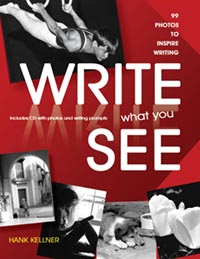
 Using Photography To Inspire Writing VI What do dogs, teenagers and fragmented photos have in common? All have the potential to prompt creative written responses from your writing students! | ||
| by Hank Kellner author of Write What You See: 99 Photographs To Inspire Writing author's blog April 1, 2009 |
||
|
||
|
If you’re as long in the tooth as I am, you can probably remember Patti Page’s rendition of “How Much Is That Doggie in the Window?” Page recorded the song on December 18, 1952, and within a few months it became Number 1 on both the Billboard and Cashbox charts. And you can probably remember James S. Tippett’s “Sunning,” a poem that appeared in one of his children’s books, A World To Know. 
SunningOld Dog lay in the summer sun Truth to tell, Tippett’s poem doesn’t contain simile, metaphor, irony, allusion, or any of the other literary devices that are found in more sophisticated works. But that really doesn’t matter. Together with one or more photos of dogs like those shown here, simple poems like “Sunning” can easily inspire students at all levels from elementary school through college to write many different kinds of compositions. Who are some famous dogs that have appeared in literature, on television, and in films? What characteristics do dogs possess that make them desirable pets? In what ways can some breeds of dogs be helpful to handicapped human beings? How have dogs proven to be helpful in the military? In law enforcement agencies? How has a dog played an important role in your life or in the life of someone you know? The questions cited above are just a few of many you can ask students as you encourage them to write either expository or creative pieces. What’s more, if you simply want to allow your students’ imaginations to guide them, you could always show them photos without comment.
The Case of the Fragmented Photo
 But that’s not the case with Kelsey Maki, an adjunct professor at Brookdale Community College, Lincroft, New Jersey. “After I cut an 8 ½ x 11-inch photograph with diverse elements into numbered pieces,” she writes, “I give a different piece to each of several students.” Then Maki asks the students to create a fictional character and write a scene in the first person from that character’s point of view. Maki also directs the students to consider the ways in which a character’s desires color his or her perception of place. At the conclusion to the exercise the students assemble the parts of the photograph to see the third person, omniscient “big picture” scene. “This activity,” concludes Maki, “helps the students realize that a setting is never an evenly focused, objective portrait, but rather a reflection of a character’s physical point of view and physical state.”
  | ||
|



 New Jobs on Teachers.Net


 Hank Kellner is a retired educator and the author of Write What You See: 99 Photographs to Inspire Writing. Original Edition. Cottonwood Press. I-800-864-4297