|  Effective
Teaching...
Effective
Teaching...
by Harry and Rosemary
Wong
April
2007
Training Gen
Y Teachers for Maximum Effectiveness
Districts
are gearing up to recruit more teachers to fill the
same positions vacated by teachers recruited the previous year.
Here’s why.
OMG. Here they come. Generation Y.

Born from 1977 to 1986, Generation Y, or the Millennials, is
a potential force of as many as 40 million. The first wave
of Gen Ys is just now embarking on their careers as classroom
teachers.
They are products of a global economy, a connected, collaborative
environment in which technology has allowed them to network.
They are knowledge workers with ubiquitous access to powerful
laptops and the know how to utilize 21st century technology and
digital resources.
They are socially adept at working in groups or teams and are
avid users of online social networking, such as MySpace and FaceBook.
A learning community is their forte, thus to work collaboratively
in a group is second nature to them.
The report of the National Commission on Teaching and America’s
Future, “Induction into Learning Communities,” states
that the development of effective teachers requires an approach
that is different in scope and design from much of what currently
passes for induction in this country: one-to-one mentoring
of a novice teacher. Unless we move beyond the traditional
one-to-one mentoring model, we will continue to reinforce the
industrial-era practice of stand-alone teaching in isolated classrooms.
The new crop of teachers are tech-savvy and poised to
be lifelong learners. If inquiry means deep thinking,
then the Gen Ys can already run circles around us veteran educators
when it comes to collecting data, finding resources, thinking
deeply, problem-solving, reflecting, and inquiring.
They are the most socially conscious generation since
the Boomers. Gen Ys are out in force working for
social causes ranging from volunteering in international areas
of poverty to teaching in urban schools through such organizations
as Teach for America.
They exude confidence and informality; they have high expectations
and are accomplishment oriented.
The Generation Y can be described in four positive ways:
1. A generation that is confident, self-sufficient, and achievement-oriented
2. A generation that is the most education-minded in history
3. A generation paving the way to a more open, tolerant society
4. A socially conscious generation leading a new wave of volunteerism
Gen Ys Learn Best by Collaboration
The Gen Ys are output oriented, success-oriented, achievement-oriented,
and thus student achievement oriented. Gen Ys live
in a global society where everyone is on the same, level playing
field sharing information and solutions to produce outcomes.
They are devoted to helping their students learn more because
they are oriented to producing outcomes. We can nurture
that skill by allowing them to produce results in groups.
Typically schools expect teachers to be creative and do a good
job behind closed doors. Collaboration is rare. Worse
yet, new teachers seldom see another classroom. Loneliness
and lack of support further exacerbate the problems of beginning
teachers.
Susan Moore Johnson of the Project on the Next Generation of
Teachers at the Harvard Graduate School of Education says, “Our
work suggests that schools would do better to rely less on one-on-one
mentoring and, instead, develop school-wide structures that promote
the frequent exchange of information and ideas among novice and
veteran teachers.”
Surround Gen Y teachers with a community of creative thinkers
and the solutions will abound everywhere. They are
great team players.
Professionals do not work alone; they work in teams.
When teachers meet in teams to focus on a problem, they become
part of a team that will work with students who need their help.
“Teachers should be in teams, working collaboratively around
problems identified in their schools that are related to students,”
says Kathleen Fulton, director of Reinventing Schools for the
21st Century for the National Commission on Teaching and America’s
Future.
Collaboration is the most effective way for teachers
to learn. Professional development is most effective
and teachers learn more in sustained teacher networks and study
groups than with individual mentors.
Everyone knows that businesses train workers in teams with specific
outcomes in mind. Schools will see improved student learning
if they harness the collective intelligence, creativity, and genius
of their teachers in consistent teams. It will become easier
to do because this is the way of life for the Y Generation of
teachers.
Gen Ys Are Our Future Leaders
By channeling their talent for working together we will see improved
student learning. Education is a collaborative endeavor.
No one individual has all the answers. We depend
on each other for the creative solutions to our problems and the
collective inspiration to design lessons that will improve student
learning.
Millennials like structure and will want schools to give them
clear rules and procedures to follow. They need to clearly
see the value of their work. They want their work to be
relevant, have impact, and offer them a diversity of experiences.
This next generation of teachers is the most intelligent,
talented, competitive (and compulsive) group this country has
seen. It’s a Renaissance generation with
much potential if we put the future in their care. They
are more interesting, more confident, less hidebound and uptight,
better educated, more creative, and even unafraid. The grandeur
of the future is in their capable hands.
Do You Recognize Yourself?
If you see yourself in the previous paragraphs, you should be
energized with the potential for yourself and your students.
However, you need to be in an environment where you can put your
talents and strengths to use. If you are a Generation Y
teacher and you are looking for a job, here is a question to ask
at the interview:
“Does this district or school have an induction
or training program
where I can work with other teachers in a learning community?”
If not, consider moving on.
There are ten other questions you should ask during the interview.
To see these ten questions, please go to our April 2001 column,
“How
to Recognize Where You Want to Be.”
The Need for Teachers Is Real
Consider these two statements found in the literature:
- “We will need 2 million new teachers in the next decade.”
- “Fifty percent of beginning teachers will leave teaching
after five years.”
These two sentences have appeared regularly over the past 30
years, yet writers make these statements as if they are brand
new. The tragedy is the solution for the past 30 years has
always been the same: give the beginning teachers a mentor.
Knowing how Gen Y teachers work and learn best:
- Will you be ushered into our profession by giving you a classroom
to teach in isolation?
- Will you be given a one-to-one mentor to be seen on occasions
and then ushered into an isolated classroom after a year of
mentoring?
If so, we know that the potential is great that we will lose
you. And we will just recruit more teachers for
the same positions over and over again.
If we continue to give you a mentor only, the same two sentences
will be used for the next thirty years. It will be the students
who will suffer from the lack of teacher improvement, because
mentoring may improve teacher retention, but there is no substantial
research which shows that mentoring improves teacher competency.
The millions of dollars spent on mentoring programs
would be better spent on team-based induction allowing a new
teacher to smoothly acculturate into existing teams of teachers.
Just think of the impact on student achievement if you, as a
beginning teacher, had access to a coach, school-based staff developer,
instructional specialist, program facilitator, curriculum developer,
and most importantly, an administrator, all as
part of your collegial team?
Training Programs that Work Together
Gen Y teachers want to be involved in a collaborative
way. Induction programs provide that connection,
because they are structured around a learning community where
new and veteran teachers treat each other with respect and all
contributions are valued. To ask a Gen Y teacher to go solo
in a networked world is writing that teacher’s epitaph.
Knowing this, the Islip Public Schools on Long Island, New York,
has a comprehensive induction program that features collaborative
study group activities and networking. This is not a mentoring
program. The three-year induction program is under the leadership
of assistant superintendent, Linda Lippmann.

At Islip, study teams focus on skill-building strategies such
as conducting parent conferences, managing classrooms, crafting
lesson plans, and implementing cooperative discipline. The
groups constantly work on team building and problem solving techniques.
They use model lessons and hold sharing sessions in which teachers
learn from each other and build respect for one another.
Teacher turnover is negligible and new teachers are immediately
ushered into a team-like culture.
In the ten year existence of the Islip induction program, evidence
of the success of their collaborative work can be seen in the
data. The year the induction program began, 34 percent of
their students earned a New York State Regent’s diploma.
At the end of the 2005-2006 school year, the figure had risen
to 97 percent. That’s correct—97 percent!
To read more about the comprehensive induction program of the
Islip Public Schools and the reaction of Mike Mitchell, Spanish
teacher, to new teacher induction, go to
www.nysaflt.org/documents/pdf/misc/journalsample.pdf.
Know what a good induction program looks like so you will recognize
the characteristics as you discuss your future employment with
school districts and principals.
Two More Models to Review
Here are two outstanding comprehensive induction programs
that warrant your attention and modeling.
Flowing Wells School District. This mother-of-all
induction programs has been in existence for over 20 years.
Located in Tucson, Arizona, this school district has produced
more state teachers-of-the-year than any other Arizona school
district. This fact can be attributed to how well they train
their teachers to become expert teachers.
To see their eight-year staff development program that takes
a novice teacher to become an expert teacher, click here.
To read about the Flowing Wells comprehensive induction program,
click here.
Lafourche Parish Schools. This school
district’s induction program is so successful that the state
of Louisiana adopted it for its state model. The director
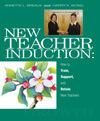
of this program, Annette Breaux, co-authored New Teacher
Induction: How to Train, Support, and Retain new Teachers.
Click here
to see this book.
To read about the Lafourche new teacher induction program, click
here.
To read the about Louisiana FIRST, the state professional development
program for new teachers, click here.
Mentoring Is Not Enough
Everyone in the world outside of schools trains their workers
and has them working in teams. Fast food restaurants, convenience
stores, giant mega stores, legal firms, hospitals, and even non-profit
organizations train their workers to a set of skills and standards.
Yet, Ted Britton at WestEd reports that in many schools one-on-one
mentoring is the dominant or sole strategy for supporting new
teachers, often lacking real structure.
Much of mentoring involves responding to a new teacher’s
day-to-day crises and provide survival teaching tips. Mentoring,
in and of itself, has no purpose, goal, or agenda for student
achievement. Thus, there is no evidence of the connection
between mentoring and student learning. To see current research
on mentoring and induction, click here.
To maximize student performance, all beginning teachers must
learn to
- teach to established standards,
- evaluate the effects of their instruction on student performance,
- use student achievement data for planning and curriculum,
- tailor instruction to address specific learning needs, and
- learn how to thrive in the culture of the school.
This kind of learning can only happen
in an
induction process that is comprehensive.
Mike Schmoker reports that “research has not been found
that supports the systematic formation of effective teachers solely
through the use of mentors, especially mentors who show up after
school begins and may not have been trained, compensated, or given
direction or goals to attain.”
Whereas, induction is a comprehensive, multi-year process
designed to train and acculturate new teachers in the academic
standards and vision of the district.
New teachers want to see other teachers teach in their classrooms
and they want other teachers to come to their classrooms to see
and advise them on their teaching. They want to be part
of the learning community of the school.
People crave connection. Mentoring, which
is a one-on-one relationship, continues the practice of teachers
operating in isolation.
What keeps good teachers are structured, sustained, intensive
professional development programs that allow new teachers to observe
others, to be observed by others, and to be part of networks,
learning communities, or grade level/subject matter teams where
all teachers share together, grow together, and learn to respect
each other's work.
The Bottom Line
The bottom line is obvious. Trained teachers become
effective teachers and effective teachers are the difference.
Districts that provide structured, sustained induction training
for their teachers achieve what every school district seeks to
achieve—improved student learning.
Be the Difference Y Gens!
To the Y Generation of teachers in or just entering
the profession—We’re stoked that you are here!
You have the 411 to be the force to change the way teachers
are ushered into this calling. Your success in the classroom
will determine the success for an entire generation of students.
Start your own group of colleagues sharing and growing together
if the school or district doesn’t present you with the opportunity.
You know how to naturally connect 24/7. Wire yourself to
like learners who have the same passion and enthusiasm for children
as you do.
Your mission and challenge is to get students to be successful.
That comes with increasing your skill and effectiveness.
It’s a very simple equation, but one so hard to implement.
Teacher Effectiveness = Student Achievement
You will not realize this in isolation. Share with us the
unique ways that you are using your peer-to-peer network to improve
the quality of your teaching. You can help others find a
means to release themselves from the seclusion of the classroom
and link with each other to grow and flourish and belong.
You can use your innate characteristics to become the
greatest generation of teachers ever to enter the profession.
We are excited by your potential and eagerly await the results
of your future.
 For a printable version of this article click
here.
For a printable version of this article click
here.
Harry & Rosemary Wong products: http://www.harrywong.com/product/
Email Harry Wong: harrywong@teachers.net
Gazette Articles by Harry & Rosemary Wong:
If you spot a link that appears to be out-of-date, please alert us at webmaster@teachers.net!
- A Grateful Goodbye After 15 Years (Jun 2015)
- Love, Marriage, and Babies, Oh My! (May 2015)
- Retention Rate Is 100 Percent (Apr 2015)
- Teacher Effectiveness and Human Capital (Mar 2015)
- Training Teachers to Be Effective (Feb 2015)
- Making Deals Is Ineffective (Dec 2014 / Jan 2015)
- Retrieving and Carrying Electronic Devices (Nov 2014)
- Sharing to Succeed (Oct 2014)
- How a University Prepares Its Students (Sep 2014)
- Effective Teaching (Aug 2014)
- Your Future Is in Your Hands (June/July 2014)
- The Classroom Management Book (May 2014)
- When Students Succeed; Teachers Succeed (April 2014)
- Teaching New Teachers How to Succeed (March 2014)
- Execute and Praise (February 2014)
- Shaping a Solid Foundation (Dec 2013 / Jan 2014)
- The Most Misunderstood Word (November 2013)
- How to Start Class Every Day (October 2013)
- Prevention: The Key to Solving Discipline Problems (September 2013)
- Planning, Planning, Planning (August 2013)
- Are You THE One? (June / July 2013)
- Practical Examples That Work (May 2013)
- A Disability Is Not a Handicap (Apr 2013)
- Totally Inexcusable (Mar 2013)
- Be Proud of Public Education (Feb 2013)
- Structure Will Motivate Students (Dec 2012 / Jan2013)
- Orchestrating the Classroom (Nov 2012)
- The Lasting Impact of Instructional Coaching (Oct 2012)
- Learning, Laughing, and Leaving a Legacy (Sep 2012)
- Twenty-two, First Year, and Legit (Aug 2012)
- A Master Teacher of Teachers (June/July 2012)
- Where Going to School Means Success (May 2012)
- A Nationally Celebrated High School (Apr 2012)
- The Highest Rated School in New York City, Part 2 (Mar 2012)
- The Highest Rated School in New York City, Part 1 (Feb 2012)
- The Importance of Culture (Dec 2011 / Jan 2012)
- You Can Teach Classroom Management (Nov 2011)
- Seamless, Transparent, and Consistent (Oct 2011)
- Coaching Teachers to Be Effective Instructors (Sep 2011)
- How a Principal Creates a Culture of Consistency (Aug 2011)
- Graduation Begins in Your Classroom (June/July 2011)
- The Inspiration of a Mother (May 2011)
- How to Be an Effective Leader (Apr 2011)
- Learning Objectives: The Heart of Every Lesson (Mar 2011)
- Even Shakespeare Had Structure (Feb 2011)
- Effectiveness Defined: It's Not a Mystery (Dec 2010 / Jan 2011)
- Surviving Without a Principal (Nov 2010)
- Achieving Greatness: Locke Elementary School, Part 2 (Oct 2010)
- Teaching Greatness: Locke Elementary School, Part 1 (Sep 2010)
- Effective from the Start (Aug 2010)
- Ten Year Summary of Articles, 2000 to 2010 (June/July 2010)
- The Success of a Culture of Consistency (May 2010)
- Training Teachers to Be Effective (Apr 2010)
- Learning to Teach, Teaching to Learn (Mar 2010)
- Turning Teaching Dreams into Reality (Feb 2010)
- Dreams and Wishes Can Come True (Dec 2009 / Jan 2010)
- Success in a State Controlled School (Nov 2009)
- Inner City Is Not An Excuse (Oct 2009)
- Exceeding All Expectations (Sep 2009)
- Teachers Are the Difference (Aug 2009)
- Nine Year Summary of Articles, 2000 to 2009 (Jun/Jul 2009)
- Teachers Are the Greatest Assets (May 2009)
- The Tools for Success (Apr 2009)
- Assessing for Student Learning (Mar 2009)
- To Be an Effective Teacher Simply Copy and Paste (Feb 2009)
- The Sounds of Students Learning and Performing (Dec 2008)
- A School That Achieves Greatness (Nov 2008)
- Boaz City Schools: Professional Learning Teams (Oct 2008)
- It Was Something Close to a Miracle (Sep 2008)
- A Computer Teacher Shows the Way (Aug 2008)
- Eight Year Summary of Articles, 2000 to 2008 (Jun/Jul 2008)
- An Amazing Kindergarten Teacher (May 2008)
- Schools That Beat the Academic Odds (Apr 2008)
- Academic Coaching Produces More Effective Teachers (Mar 2008)
- Coaches Are More Effective than Mentors (Feb 2008)
- Wrapping the Year with Rap! (Dec 2007/Jan 2008)
- The Floating Teacher (Nov 2007)
- Taking the Bite Out of Assessment—Using Scoring Guides (Oct 2007)
- Ten Timely Tools for Success on the First Days of School (Sep 2007)
- First Day of School Script - in Spanish, Too! (Aug 2007)
- Seven Year Summary of Articles, 2000 to 2007 (Jun 2007)
- Effective Teachers End the Year Successfully (May 2007)
- Training Gen Y Teachers for Maximum Effectiveness (Apr 2007)
- Classroom Management Applies to All Teachers (Mar 2007)
- Students Want a Sense of Direction (Feb 2007)
- Rubrics in Two College Classes (Dec 2006/Jan 2007)
- How to Write a Rubric (Nov 2006)
- Assessing Student Progress with a Rubric (Oct 2006)
- A 92 Percent Homework Turn-in Rate (Sep 2006)
- Effective Teachers Are Proactive (Aug 2006)
- Five Year Summary of Articles (Jun 2006)
- Hitting the Bulls Eye as a Beginning Teacher (May 2006)
- They're Eager to Do the Assignments (Apr 2006)
- The Success of Special Ed Teachers (Mar 2006)
- What Teachers Have Accomplished (Feb 2006)
- Fifty Years Ago, The Legacy (Dec 2005/Jan 2006)
- The Emergency Teacher (Nov 2005)
- Classroom Management Is Not Discipline (Oct 2005)
- A Successful First Day Is No Secret (Sep 2005)
- The Most Important Factor (Aug 2005)
- Four Year Summary of Articles (Jul 2005)
- Improving Student Achievement Is Very Simple (Part 2) (Jun 2005)
- Improving Student Achievement Is Very Simple (Part 1) (May 2005)
- Never Cease to Learn (Apr 2005)
- His Classroom Is a Real Life Office (Mar 2005)
- The Power of Procedures (Feb 2005)
- The First Ten Days of School (Jan 2005)
- PowerPoint Procedures (Nov/Dec 2004)
- The Saints of Education (Oct 2004)
- How Procedures Saved a Teacher's Life (Sep 2004)
- How to Help Students with Their Assignments (Aug 2004)
- Three Year Summary of Articles (Jun/Jul 2004)
- His Students are All Certified (May 2004)
- What to Do When They Complain (Apr 2004)
- A Well-Oiled Learning Machine (Mar 2004)
- The Effective Teacher Adapts (Feb 2004)
- How to Start a Lesson Plan (Aug 2003)
- Applying for a Teaching Job in a Tight Market - Part 2 (Jun/Jul 2003)
- Applying for a Teaching Job in a Tight Market (May 2003)
- The Effective Substitute Teacher (Apr 2003)
- A First Day of School Script (Mar 2003)
- How to Retain New Teachers (Feb 2003)
- No Problem With Hurricane Lili (Dec 2002)
- A Class Size of 500 (Nov 2002)
- Effective Practices Apply to All Teachers (Oct 2002)
- Dispensing Materials in Fifteen Seconds (Sept 2002)
- How To Start School Successfully (Aug 2002)
- Teaching Procedures Is Teaching Expectations (June - July 2002)
- $50,000 to Replace Each Teacher (May 2002)
- Even Superintendents Do It (Apr 2002)
- Impossible, No Job Openings? (Mar 2002)
- A Stress Free Teacher (Feb 2002)
- A Most Effective School (Jan 2002)
- Van Gogh in Nine Hours (Dec 2001)
- The Effective Teacher Thinks (Nov 2001)
- How a Good University Can Help You (Sep 2001)
- How to Motivate Your Students (May 2001)
- How to Recognize Where You Want to Be (Apr 2001)
- What Successful New Teachers Are Taught (Mar 2001)
- A Journey of the Heart (Feb 2001)
- The Miracle of Teachers (Jan 2001)
- It's Not the Students. It's the Teacher. (Dec 2000)
- The First Five Minutes Are Critical (Nov 2000)
- How to Start a Class Effectively (Oct 2000)
- The Problem Is Not Discipline (Sep 2000)
- There Is Only One First Day of School (Aug 2000)
- Applying for Your First Job (Jul 2000)
- Your First Day (Jun 2000)
Browse through the latest posts from the Classroom Management
Chatboard...
- introduce myself!, 2/05/26, by Innerpeaceful One | Study Timers & Sleep Music.
- intorduce myself, 2/05/26, by Innerpeaceful One | Study Timers & Sleep Music.
- classroom management resources, 2/05/26, by Innerpeaceful One | Study Timers & Sleep Music.
- Re: Learning by doing, 4/22/22, by WendyF.
- Re: Learning by doing, 4/22/22, by WendyF.
- Re: Learning by doing, 4/22/22, by WendyF.
- Re: Learning by doing, 4/22/22, by WendyF.
- Re: Learning by doing, 4/22/22, by WendyF.
- Re: Learning by doing, 4/22/22, by WendyF.
- Classroom Management and SRL, 2/08/21, by monh.
- Class Updates Application, 2/02/18, by edtechguru.
- Re: how do you manage the different learning styles?, 1/16/18, by Steven G.
- Re: Respectful and Responsible , 1/09/18, by Linda.
- Re: how do you manage the different learning styles?, 1/03/18, by Linda.
- how do you manage the different learning styles?, 12/28/17, by smgalbr810.
- Re: Why I'll Never Say "Don't Smile Until Christmas", 10/02/17, by CrystalB.
- Re: Positive Reinforcement, 10/02/17, by CrystalB.
- Re: Learning by doing, 10/01/17, by CrystalB.
- Re: Intrinsic Motivation - making sure we stay on task, 10/01/17, by CrystalB.
- Re: Intrinsic Motivation - making sure we stay on task, 10/01/17, by Heather S..
- Re: Is Positive Reinforcement Enough?, 10/01/17, by mollyh.
- Re: Is Positive Reinforcement Enough?, 10/01/17, by Heather S..
- Re: Is Positive Reinforcement Enough?, 9/30/17, by CrystalB.
- Re: Intrinsic Motivation - making sure we stay on task, 9/30/17, by CrystalB.
- Intrinsic Motivation - making sure we stay on task, 9/30/17, by CrystalB.
- Re: Respectful and Responsible , 9/30/17, by Alexandra Sletten.
- Re: Respectful and Responsible , 9/30/17, by Ines K.
- Is Positive Reinforcement Enough?, 9/30/17, by Heather S..
- Re: Respectful and Responsible , 9/29/17, by Anne R.
- Re: Respectful and Responsible , 9/28/17, by Samantha M.
- Re: Rewards, 9/28/17, by Samantha M.
- Re: Rewards, 9/28/17, by Kaylee H.
- Re: Respectful and Responsible , 9/28/17, by mollyh.
- Re: Rewards, 9/28/17, by mollyh.
- Re: Learning by doing, 9/28/17, by Heather S..
- Why I'll Never Say "Don't Smile Until Christmas", 9/27/17, by Bob R/CA.
|


 Chatboards
 Mailrings
 Classifieds
 Lessons
 Jobs
Jobs
 Projects