|

 Chatboards
 Mailrings
 Classifieds
 Lessons
 Jobs
Jobs
 Projects
|
  |

Effective Teaching... by Harry and Rosemary Wong
To print: Select File and then Print from your browser's menu
------------------------------------------------------------------
This article was printed from Teachers.Net Gazette,
located at https://teachers.net.
------------------------------------------------------------------
December 2006 - January 2007
Rubrics in Two College Classes
Close your eyes and visualize: A new teacher
Walking into his or her classroom
On the first day of school
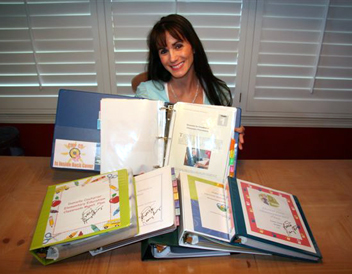
With a Classroom Management Plan binder in hand.
What do you see? Calmness
Confidence
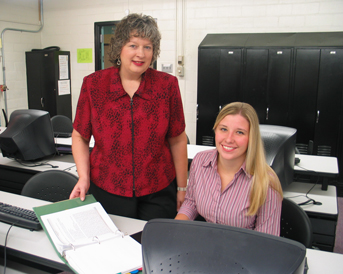
Success!Dr. Lena Nuccio-Lee, Assistant Professor of Professional Practice at the University of New Orleans, was given a few hours to get on campus, gather what she needed out of her office, and get out. With no utilities in the building after hurricane Katrina, she went straight to her dimly lit, musty office and took her desktop computer and her textbooks.
If the University of New Orleans was to reopen she said, “We were not going down without a fight; we had to offer almost all of our typically, on campus courses, online. Before Katrina, very few students had taken online courses and few faculty members had experience teaching in an web-based environment.”
“What a rude awakening!” she says.
She found out only two days before the start of the semester that she would be teaching 140 students online.
She had none of her course materials at home and the university was not allowing anyone on campus. So when a sliver of hope was granted by letting staff on campus for a few hours, she went quickly.
EDUC 3110 – Behavior Support and Classroom Management
One course she taught was EDUC 3110- Behavior Support and Classroom Management. The course description says that this course focuses on classroom management within school settings. It includes procedures for group behavior management, strategies for assessment and responding to individual student behavior, using a problem-solving approach for changing behavior, and supporting appropriate behaviors in learning activities and settings.
Most of her course rubrics were on the computer she brought home. With relief, Lena says, “Rubrics make the students' lives much easier, but once written, they make the professor's life easier, too.”
She continues, “Rubrics became extremely important during the Katrina semester. As you can imagine, at a time of such uncertainty, it was reassuring for students to know exactly what was expected of them with respect to specific assignments.”
To review the concept of rubrics, please go to our past two columns, October 2006, “Assessing Student Progress with a Rubric” and November 2006, “How to Write a Rubric.”
Two students, one in each column, say:
“A rubric is a scale that teachers may use to grade an article of writing from their students. I like rubrics because they make the student aware of exactly how to answer the questions or write the assigned article, and it plots a very fair and easy-to-understand grading system. A rubric creates a backbone for your paper.”
"Having the rubric was like having the poem in front of me. The rubric guided me through the process of writing the poem, when otherwise I would have been clueless."
This is what two of Dr. Lee’s students say about having a rubric:
Lauren Lunt says, “I like rubrics because they outline exactly what is expected of you and how to earn a grade. It also told me that she was prepared to teach.”
Rusty Templet says, “Just as a blueprint supplies dimensions and details on the internal and external construction of a house, a good rubric will supply enough detail and direction to help students construct and complete their assignment successfully. Her rubric for the course and the execution in addressing its detail were flawless.”
The Rubrics for EDUC 3110
Dr. Lee uses two rubrics for her classroom management classes.
- Classroom Management Plan rubric
- Transition Strategy rubric
To see these two rubrics, click here.
The goal of the Classroom Management Plan (CMP) rubric is for the student to create a binder with their own Classroom Management Plan.
The goal of the Transition Strategy rubric is for the student to create and provide instructions on how to teach and have effective transitions in a classroom. Transitions are those times in the classroom when students are to move from one task or procedure to another.
Her course requirement states:
“As you read the texts and other assignments for this course, you should highlight ideas that you would like to incorporate in your classroom. These are the types of things that you will include in your CMP. You may already have ideas of your own, or that you have borrowed that you know you would like to include.
“This is your plan, and you design it to meet your needs. When you borrow ideas from your readings, resource books or other notable places, remember to cite the references, and then include them in a reference list.
“Some of the obvious things that you would have in your CMP are the following: rules, consequences, seating charts, procedures, quotes you may display, procedures for the first week of school, attention getters, transition strategies, and any other thing that you think are important for the management of your classroom. Refer to the rubric for this assignment.”
The Classroom Management binder the students create is very similar to the Classroom Management binder that Sarah Jones (now Sarah Jondahl) prepared when she attended West Kentucky University. To read about this binder and how Sarah Jones became successful in her first year as a teacher, please read “How a Good University Can Help You” in our September 2001 column.
Close your eyes and visualize how successful you will be with your own classroom management plan in a binder.
You can create your own binder by taking an eLearning course at
Validation of Lena Nuccio-Lee’s Online Course
Katrina notwithstanding, Dr. Lee’s classroom management class was held online and this is what students, Lauren Lunt and Rusty Templet, said about their experiences:Lauren Lunt says,
“Dr. Lee's online Classroom Management class at UNO was organized and predictable. We read each week from Drs. Harry K. Wong and Rosemary T. Wong's, The First Days of School and C.M. Charles and Gail W. Senter's Elementary Classroom Management and posted individual reflections online. The reading was both interesting and informative.
“One or two pieces of our classroom management plans were due weekly, and we were allowed to edit and resubmit with no penalty if necessary, which was very encouraging. The system made the overwhelming, seemingly broad project of a classroom management plan more manageable for us. By breaking it down to prevent confusion and panic among students, allow instant and specific feedback to students, and to make grading less general and less overwhelming for her, Dr. Lee was demonstrating the classroom management skills that she was teaching.
“Overall, the class ran smoothly. Because it was an online class, and Dr. Lee could not require face-to-face meetings, she instead announced at the end of the course that she would be available in her campus office for optional, individual meetings about CMPs.
“By making herself available, she ended the course on a note that said she cared about our work enough to want to personally review it with each and every one of us.“
Rusty Templet says,
“I’m not sure if the environment and the camaraderie was one spawned from being survivors of hurricane Katrina, but there was no lack of dedication, intensity, and passionate within this classroom.
“This was an interactive class that, although it addressed information in the text, focused on creating a plan for us to be successful teachers (via our CMP). As we completed small components of our CMP, Dr. Lee would review them weekly and would supply us with feedback to improve our work.
“All of us were artists creating a work of art, not to be unveiled until the last class of the semester. On that day, there were many successes to be unveiled with much discussion, laughter, and mirth. The First Days of School was referenced many times in class and was very valuable to all.
“Dr. Lee took personal pride in her work and her students, as she arrived enthusiastically for each class. Her rubric for the course and the execution in addressing its detail was flawless.
“I attribute the outcome of my CMP (Classroom Management Plan) to Dr. Lee, her instruction, attitude, and her rubric.
“All courses and instructors are not created equal, and I am happy to say that I had a diamond for an instructor.”
This diamond of a teacher received the following letter from a former student:
“It’s Vanessa Flores; remember me? I was in a couple of your classes. One of them was Classroom Management last fall. Anyway I wanted to give you an update because I am now teaching Spanish full time in Cleveland, Ohio. I moved here a couple of months ago because my husband had to relocate in order to finish his residency.
“What I want to let you know is that I have been using my Classroom Management Plan (CMP) to set up my classes. I must admit that at the time I thought some of the things you assigned were not necessary.
“I now realize that no matter the age group classroom management is very, very important and crucial to a successful year for both the teacher and the students.
“Again thanks... your forever grateful student.”
Vanessa
Classroom Management in Galveston, Texas
PACT stands for Partners in Alternative Certification for Teachers and is Galveston County’s Alternative Teacher Certification Program. The PACT program is an alternative teacher certification program created by two local Texas community colleges, College of the Mainland and Galveston College, to recruit and train post-baccalaureate individuals interested in teaching.
They partner with the Galveston County independent school district, as well as state-approved charter and private schools, to help them meet their teacher shortages by supplying them with highly qualified teaching professionals and have since assisted almost 300 new teachers in reaching full state certification. More information can be found at www.pact4teachers.com/about.htm.
Carla Boone, Director, Teacher Education Center, conducts the classroom management course at the College of the Mainland for the PACT.
College of the Mainland is a community college located in Texas City, Texas, near Galveston.
Some highlights from the syllabus are:
- The purpose of the course is to teach the user how to structure and organize a classroom for maximum student learning time. By the end of the course, the user will have created a binder containing a personal Classroom Management Action Plan.
- This online course is designed to improve the quality of the teacher’s classroom management skills so he or she can maximize student learning time.
- Students will submit the Classroom Management Action Plan to the PACT instructor within one week of course completion for assessment.
To see how student work will be assessed, click here to see the online course scoring rubric.
This is what Carla Boone says about the rubric:
“Throughout my teaching career, I have utilized various styles of rubrics. The structure of the rubric has varied with the type of project assigned. If distributed to students at the same time the assignment is initially given, I have found them to be excellent guides that motivate students to contribute their best efforts.
“Conversely, I have experienced with my own children, that when teachers fail to provide guidance for activity and project based activities, students who wish to excel will flounder and become frustrated as they do not clearly understand what the teacher expects from them.”
A student, Susan Montes, says,
“The course rubric was extremely helpful. It gave me a clear explanation of what was expected of me in order to receive a satisfactory completion of the course. It was also helpful in providing step-by-step instructions of how the Classroom Management binder needed to be organized.”
Carla said that she became aware of our online Classroom Management course (www.ClassroomManagement.com) earlier this year and began offering the course as a professional development opportunity to teachers that had previously trained and who were participating in their Transition to Teaching Grant. These teachers were committed to work in high-need school districts for three years, and most had just completed their first year of teaching.
About 70 teachers completed the Classroom Management course over the summer.
- Many of these teachers told her that the course taught them so much and had equipped them with new practices they could implement in the new school year.
- Others, it appeared, quickly went through the course and did not take the time to complete some or all of the binder pages and, therefore, did not really grow professionally from this learning opportunity.
As a result of this first offering and the positive comments heard from those teachers who took the time to complete the course learning activities, they decided to require this Classroom Management course of all new PACT students.
To assess the new students at the completion of this online course, Carla realized that it would be necessary to create a scoring rubric. She said, “I have always believed that students must know what is expected of them from the beginning.
“If they know the expectation at the beginning of the course, they know how to approach their learning activities. A scoring rubric establishes and solidifies the expectation and, if written well, clearly communicates to the student how their product will be assessed. I particularly like utilizing rubrics for project or activity based learning.”
She further says, “This particular rubric clearly identifies the course requirements (items to be included in the binder) so that students know exactly what documents should be included in their final product. It also identifies the total points, or point value, for each item to be included in the binder and a definition of the values 1-5 (Unacceptable — Excellent) so students know the extent of understanding we want conveyed for each course requirement.
“The final column allows me, the campus instructor, to complete the assessment based on the initial expectation. Once assessed, I will return the completed form to the student so they can review total points earned (final course grade).
Rubrics Improve Student Learning
As a student, did you ever raise your hand and ask of the teacher, “How will you be grading us?”
Everyone wants to know up front how they will be scored, judged, and scrutinized. And did you ever have a teacher who passed papers back to you, took off points for some omission, and you muttered under your breath, “That’s not fair. You did not tell us how we were going to be graded.”
Our jobs as teachers is to create success for students. Rubrics are the road maps to that success. Students know up front what the expectation is and you know how you are going to grade it. Scores should not be a surprise to the student. Based on the rubric, the students should be able to get a good estimate of the final grade.
Having a rubric makes communications with the home easier as well. Parents, guardians, aunts, uncles, grandparents, care givers—all know the expectation for completion of a paper, project, or report, and how it will be scored. The home can use the rubric as an aid to help the child succeed.
Students love classrooms where they know how it will be run.
- These are the classrooms with procedures in place and students are
responsible to those procedures.
- These are the classrooms with rubrics in place and students are
responsible for their learning.Students love teachers who share with them the expectations for success in the class.
We all want to succeed. Look at ways you can add a rubric to what you teach. You’ll be able to point your students down the road of success with this simple tool.
Close your eyes and visualize:
Your classroom
Filled with students
learning and achieving.
What do you see?
Calmness in the students as they know how their learning will be assessed.
Confidence in yourself as a professional with the skills needs to help children grow and learn.
Success!
Harry & Rosemary Wong products: http://EffectiveTeaching.com
This printable version is provided for the convenience of individuals.
Reproduction of multiple copies requires permission from editor@teachers.net.
Canter Courses
Choose the Master’s Degree Program that Fits Your Interests and Your Schedule
AIU Online
Master's, Bachelor's, Associate's. Get the degree you need to pursue the career you'll love!
University of Phoenix Online
University of Phoenix Online. The campus is virtual. The degree is real.
Jones Intl University Online
Designed for education professionals in corporate training, educational leadership, and K-12 teaching and administration
Home Search Contacts Chatboards Lessons Mailrings Jobs Refdesk Webring PR Advertise
© 1996 - 2004. All Rights Reserved. Please review our Terms of Use, Mission Statement, and Privacy Policy.
# 187042