|

 Chatboards
 Mailrings
 Classifieds
 Lessons
 Jobs
Jobs
 Projects
|
  |

Effective Teaching... by Harry and Rosemary Wong
To print: Select File and then Print from your browser's menu
------------------------------------------------------------------
This article was printed from Teachers.Net Gazette,
located at https://teachers.net.
------------------------------------------------------------------
December 2007 / January 2008
Wrapping the Year with Rap!
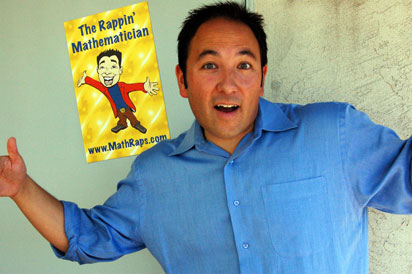
Meet Alex Kajitani, the 2007 Middle School Math Teacher of the Year for Greater San Diego.
Alex teaches in Escondido, California. His middle school is in a primarily Latino neighborhood, and is one of the lowest-performing schools in the district in one of the most poverty-stricken areas in the state. Teaching at this school, he was constantly fighting against poverty, gang recruitment, and disinterest in school.
A few years ago, Alex was having a hard time teaching Algebra. The students would not pay attention, do their work, or retain a simple math formula. But, he noticed the students could recite every word of a new hip-hop song on the radio.
So, he began searching for classroom-appropriate raps to play for his students, but was told at a hip-hop record store that none existed. Alex was not surprised as his students would come in singing about violence, drug use, and mistreating women.
Like any good teacher, Alex did not let this diminish his enthusiasm and drive for what he wanted to do. So, he went home and wrote a rap song about the math concept he was teaching and came in the next day and performed the song for the class. It was a hit! When he walked past the lunch tables that day, the students were all singing his song!
Alex began calling himself “The Rappin’ Mathematician.” His performances and the songs would soon become legendary throughout the district.
Alex jokes that he originally tried math rappin’ “out of desperation,” trying to connect with the students as a new teacher.
The songs were a smash as students throughout the school started singing the catchy lyrics about math concepts. Not only were his students finally tuning in, but their math test scores shot up, too.
In fact, Alex’s students have tested above district averages and many have become involved in making videos of the math raps. One video won an iVIE (Innovative Video in Education) award for best student film.
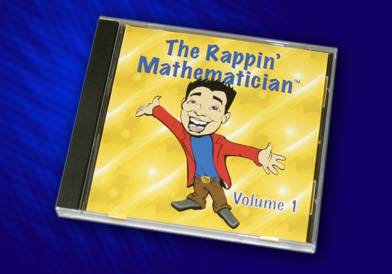
After trying out his math raps in low-performing schools in two different school districts and finding the same enthusiastic reaction from students, other teachers, and parents, Alex decided to trademark his math-rappin’ character, The Rappin’ Mathematician, and produced a professional CD of his raps.
“The Rappin’ Mathematician” CD offers songs with easy ways to remember pivotal math concepts, such as improper fractions (“if it’s bigger on the topper, it must be improper”) and adding or subtracting decimals (“line up the dot and give it all you’ve got!”).
Alex has produced two CDs. Here (and hear!) are the rap songs on Volume 1:
- “Bigger on the Topper” introduces The Rappin’ Mathematician, where he’s from, and his background, and introduces methods to identify an improper fraction.
- “The Itty Bitty Dot” discusses the decimal point, how it is used in numbers, and how to add and subtract numbers that have decimals in them. Click here once to listen. (Note: If your browser has Google Toolbar or other similar plug-in, you may need to turn off its pop-up blocking feature temporarily.)
- “Just Because” addresses positive values and media literacy, such as not believing everything you see on TV, hear on the radio, and witness in movies and video games. Click here once to hear “Just Because.”
- “The Number Line Dance” gives students a way to remember positive and negative numbers, how to add them, and how to identify them on the number line.
- “Test Tiiiiime!!!” gets students ready to take a test, and discusses test-taking strategies, as well as being confident while taking the test.
- “So Many Lines” helps students identify different types of lines and where they are used in the world. The song covers parallel, perpendicular, vertical and horizontal lines, and provides catchy rhymes for remembering each type.
- “Another Day” gives students the mindset and language to say no to drugs and negative influences, such as gangs, as well as the confidence that it is “cool” to be smart, and to plan for one’s future.
- “The Vocab Lab” discusses terms used in math, such as sum, difference, product and quotient. It also provides students with opportunities to practice each skill.
- “Math is Everywhere” celebrates that everything in the world is somehow related to math, and helps students identify different geometric shapes, such as rectangles and spheres, and where they exist in our everyday lives.
- “Increase-Decrease” discusses the definitions of, and differences between these two important words, which are so often found in math word problems.
- “PEMDAS Boss” gives students the memory tools to understand and use the order of operations—an important concept in pre-algebra and algebra.
- “Math Rappin” discusses the parts of a circle, invites students to become part of the “Math Raps Crew,” and to rap about math as often as they can!
The “Routine Rhyme”
While math motivation among his students was high, Alex continued having discipline problems, which took away from valuable teaching time.
Walking into class one day, he overheard one student say to another, “Man, we do the same thing in this class every day!” It was then that he realized they knew the procedures in his class; however, they didn’t think of them as anything beneficial.
Since the “math raps” were working so well, and making math “cool” to them, he decided to write “The Routine Rhyme,” in order to liven up the procedures and make them meaningful in his classroom.
As he explained the procedures to his students on the first day of school (and each day thereafter for the rest of the week), he taught them the rhyme with which to remember each procedure.
He kept each rhyme simple and easy to remember. Each day, the class practiced “The Routine Rhyme,” and it only took a few days for them to memorize it—just like the rap songs on the radio!
Now, he has very few problems with students being off-task. Whenever a student is not following procedures, another student will rap the line from the song, “Routine Rhyme,” telling the off-task student what to do. Thus, the rap song acts as a form of self-correction for the students and a no-cost, time-saving classroom management tool for Alex!
He says that “Routine Rhyme” has dramatically increased classroom time-on-task and productivity.
Click here once to listen to “The Routine Rhyme” and as the kids do, play it often and play it loud!
The Rappin’ Mathematician
Alex is a rap fan with a Bachelor’s degree in sociology and a Masters degree in educational curriculum and instruction. He believes that it is important to make the raps “authentic” to really connect with his students. This means that, along with the math, the songs include mentions of The Rappin’ Mathematician’s neighborhood and mixed ethnicity, as well as stories of how he lived his life.
He is of mixed ethnic background (Japanese/Jewish) and speaks Spanish—and most of his students are native Spanish-speakers. He keeps in his classroom the abacus his Japanese grandfather used in the grocery store he opened over 50 years ago after immigrating to the U.S.
He wrote many of his math raps while rocking his newborn daughter, Senna, to sleep.
His wife, Megan, is a back-up vocalist on the CD and an influence for his songs—encouraging students to question what they see on TV. She has a Master’s degree in Media & Cultural Studies.
Alex knew that the rap songs had to be real for the kids to buy into it. He says, “The math is in there, but so is rap culture, which allows them to listen to it, learn, and still feel ‘cool.’”
More information on Alex Kajitani and his CDs can be found at www.mathraps.com.
On his website, be sure to read the story from the North County Times.
A Chance Meeting
Harry met Alex Kajitani at a conference in San Diego where they were both on the program that focused on At-Risk students. However, the conference was not called “At-Risk,” it was called “At-Promise.” Yesss!!!
It’s just like the old question—is the glass half full or half empty? The program directors for the conference in San Diego choose to focus on the positive potential of kids. Their organization is called Reaching At-Promise Students Association or RAPSA. Its goal is to meet the needs of a diverse at-promise (also known as “at-risk”) student population. Information can be found at www.rapsa.org.
At the conference, Alex approached Harry and said, “I would not be the teacher I am today without your fantastic work.” (Thanks Alex for such flattering words. But, you are one who is fantastic as you have taken our simple concepts and made them sing in your classrooms.)
Alex shared with Harry that he was on the program doing a workshop called “Making Math Cool,” designed to help teachers combat the negative stereotypes of mathematicians as “nerdy,” and provide teachers with ways to make math engaging and “cool” for students.
We are so taken with his creativity and his ability to reach his students, we asked if we could share his work with our teachers.net readers. And it is our pleasure to share it with you in this column.
A Structured Start
Even though Alex’s reputation now precedes him at his school, he doesn’t start rapping to students right away on the first day of school. He first sets the classroom for learning by sharing his organizational style, his expectations of school as a serious learning place, and that he is responsible for what happens to his students while they are in his class. He sets a very high control, high support culture for his classroom the first few weeks of class and maintains it throughout the year.
Once the students have solidly gotten on the program, a structured routine based on the principles from The First Days of School, which Alex and his students call “Kajitani Style, ” he slowly introduces the raps to reinforce his math lessons. Then, the fun—including student math rap-writing and performing—begins for Alex and his students.
The Music Inside
Whether it is
rap, rock, or Broadway show tunes,
jazz, hip hop, or classical symphonies,
folk, gospel, or rhythm and blues,
country, disco, or soul,
doo wop, Latin, or reggae,
or whatever makes your toe tap and stirs your soul,
the students in your classroom feel the same way, too.They are waiting to be moved and engaged and it’s up to us, the teacher, to provide the motivation to make it happen. What Alex Kajitani has done is taken his content and presented it in a way for students to relate to. He has not dumbed down his curriculum. In fact, he has extracted the content’s purest essence and repackaged it in chunks palatable for his students.
We don’t expect you to become the newest rap sensation, but we do expect you to not give up on your students. Alex’s students had potential and once it was unleashed, their test scores soared. We would venture to say that learning for Alex and his students is now a joyful experience. Take from his lead and find the music inside of your students and let them sing with success.
It’s a Rap! And a Wrap for 2007
(Done to the tune of “The Itty Bitty Dot”)Now what in the world can you learn from Alex
He seems to have a style that’s not from the text.He’s taken procedures and applied them to rap
It’s the way to relate
Whether you like or not.Learning can be fun
But you must take the lead
Use The First Days of School
And your kids will succeed.Just listen to Alex
To hear how it’s done.I said,
Just listen to Alex
To hear how it’s done.And when you get the groove
Your class will just sing
Remember to relate
Cause that’s the first thing.Just listen to Alex
To hear how it’s done.Come on,
Just listen to Alex
To hear how it’s done.
Harry & Rosemary Wong products: http://EffectiveTeaching.com
This printable version is provided for the convenience of individuals.