|  Effective
Teaching...
Effective
Teaching...
by Harry and Rosemary
Wong
February
2008
Coaches Are
More Effective than Mentors
The research is very specific: Well
trained, proficient and effective teachers produce student learning.
Administrators—Why do you keep doing this?
Each year schools spend $7.3 billion recruiting and hiring the
same new teachers to replace the same teachers hired the year
before. They are given a mentor, yet the attrition rate
stays the same and student learning does not improve. When
the next new teacher is hired, he or she is given a mentor, too.
No one ever stops and analyzes why the pattern keeps repeating
itself.
One-on-one mentoring does not improve student learning.
Click
here to see the research.
New Teachers—Why do you keep doing this?
You’ve invested tens of thousands of dollars preparing to
be a teacher with the intent of making a difference in the lives
of young people. You are eager, dedicated, intelligent,
compassionate, and want to teach. And yet, you don’t
know anything about the district that is hiring you.
In which district would you like to work?
District 1: You are given your assignment
and told to go and teach—on your own. You may be
given a mentor, a veteran teacher down the hall, who may be
of help, if asked. Or, the mentor may be a full time mentor
who has been given a case load of 14 teachers and the mentor
comes around once a week or every other week to see you for
an hour.
District 2: You are given a mentor,
several coaches, lead teachers, administrators, and a host of
activities all designed to fulfill the potential in you. This
is what you get in the Hopewell City Schools.
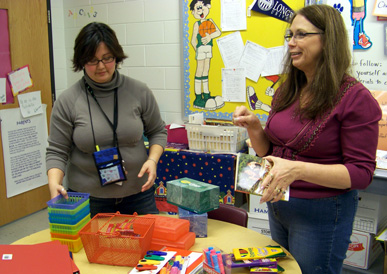
And if you have been hired at Carter G. Woodson School in Hopewell,
Virginia, the new teachers are given a SHOWER. The teachers
celebrate your arrival by putting out boxes and baskets where
the other teachers can place materials for bulletin boards,
sticky-notes, crayons, books, and necessities of the classroom.
Then, the staff helps you, the new teacher, set up
your classroom!
Hopewell’s Formula for New Teacher Success

Linda Hyslop, Assistant Superintendent for Instruction in the
Hopewell City Schools in Virginia, says, “We cannot promise
our new teachers big bucks like the surrounding big school divisions
but we can offer support and quality staff development.
As a result, teachers return to teach in Hopewell after leaving
for what they thought would be happiness by making more money.”
The Hopewell City Schools is a highly distinguished Title 1 school
system and a Standard and Poor’s Outstanding School Division.
Hopewell has had a large turnover in the last three years due
to retirement and licensure issues. Thus, the induction
program takes on greater importance. The reason
Hopewell succeeds with its new teachers and its students is because
they have a comprehensive new teacher induction program.
- To see a brochure summarizing the Hopewell New Teacher Induction
program, click
here.
Common sense would tell you that in every aspect of life, people
are given a full complement of activities and people to train
and support them from the day they come on the job until the day
they leave.
Comprehensive training programs are the norm for most jobs.
Ask the fire chief, the store manager, or hospital executive what
they do with new employees. Ask the baseball manager, construction
foreman, or senior partner in a law firm what they do. Ask
the workforce at Domino’s Pizza, Starbucks, The Cheesecake
Factory, and McDonalds. They all will tell you that every
employee is trained. And in most cases, the training continues
until the employee leaves the company.
Even the best educated of new employees need on-the-job
training. Despite completing college and medical
school, doctors spend years working as hospital residents before
entering private practice. Newly elected judges, armed with
law degrees and years of experience, attend judicial college before
assuming the bench. Pilots receive initial training and
recurrent training every time they change positions, such as from
co-pilot to pilot, and when they fly a different type of plane,
such as from a 737 to a 757.
Many People to Help You Succeed
In the Hopewell City Schools, new teachers are given a full complement
of activities and skilled people to help them become proficient
and effective.
Proficient: possessing knowledge and
skills
Effective: able to produce results
Every new teacher in Hopewell has access to the following complement
of people:
Buddy: This is an assigned teacher to
serve as a buddy to whom the novice teacher can turn for immediate,
simple help, such as answers to school procedural questions or
quick advice. Hopewell correctly designates this teacher
a buddy and not a mentor.
| The Buddy’s Responsibility |
- Makes the new teacher feel welcome.
- Helps the new teacher find the essentials.
- Provides information on routines, procedures, and
the unwritten roles.
- Shares ideas.
- Provides a sounding board and some nonjudgmental advice.
- Is a support.
|
Coach: This is a teacher with expertise
in classroom management and instructional skills. There
are presently at least four in each school and their role is to
coach, as their title implies, for skill in classroom management
and instruction.
| The Coach’s Responsibility |
- Provides instruction in skills for effective teaching.
- Provides instruction in classroom management.
- Assists in procedures and routines.
- Assists in planning instruction and refining organizational
skills.
- Models effective teaching.
- Team teaches.
- Develops intervention plans for struggling students.
- Collaborates with teachers in grade level and vertical
team meetings.
- Demonstrates best practices in instruction and classroom
management.
- Demonstrates organizational skills.
- Models professionalism.
- Observes the new teacher.
- Meets with the principal and goes over assessments,
progress, and suggestions for improvement.
|
Lead teacher: This is a teacher who can
help with subject matter questions. There are five on each
campus, each specializing in one of five areas—English,
math, science, social studies, and technology. The lead
teachers coach for desired results.
| The Lead Teacher’s Responsibility |
- Is knowledgeable in the state Standards of Learning
(SOL).
- Has expertise in SOL test data interpretation.
- Understands the connections within and across disciplines
to support student achievement.
- Identifies the best practices in instruction.
- Models professionalism.
- Reviews scope and sequence of curriculum.
- Reviews Standards of Learning Blueprints and Curriculum
Framework.
- Reviews curriculum maps.
- Provides resources.
- Provides technical assistance.
- Provides staff development.
- Models lessons.
|
All of the coaches and lead teachers receive training, teach
in the same building, and receive release time to observe and
assist. Coaches and lead teachers are financially compensated
for attending conferences. They then do follow-up training
on what they have learned.
Administrative Support and Monitoring:
In addition, the new teachers receive assistance from staff developers
and administrators from both the central office and the building
site.
| The Principal’s Responsibility |
- Are the instructional leaders for the school.
- Supervise instruction in their building.
- Are pivotal in ensuring that all teachers are effective
at helping their students learn.
- Are responsible for evaluating teachers.
|
The principals realize the clinical supervision model for
all teachers is an excellent tool to teach, not to rate.
Thus, the new teachers are taught to analyze and reflect on
their own lessons.
| The Central Office Staff’s Responsibility |
- Provides coordinators to assist at each site
|
The assistant superintendent, Linda Hyslop, structures and
coordinates the new teacher induction process and keeps a vision
for the program.
Many Activities to Help You Succeed
In addition to having access to competent people, Hopewell provides
a varied set of activities, such as these:
- Upon signing their contract, new teachers are given a copy
of our book, The First Days of School,
and Robert Marzano’s books, Classroom Instruction
That Works and Classroom Management That Works.
- Four days of orientation and workshops before all staff return.
The first day includes time on core curriculum, special education,
Standards of Learning (SOL) for Virginia Public Schools that
describe the commonwealth's expectations for student learning
and achievement in grades K-12. The second day is devoted
to Skills for Effective Teaching (SET), the Madeline Hunter
Model. The third and fourth days focus on technology training.
- A field trip during orientation takes the teachers around
the community and ends at a historical home where the Historic
Hopewell Foundation welcomes them.
- A "welcome" breakfast is hosted by the Chamber of
Commerce.
- Three years of ongoing, structured training and support is
provided by the SET coaches.
- Selected events from the Pathwise Induction Program, formerly
distributed by the Educational Testing Service, are conducted.
These activities are used with teachers having no experience
to augment the SET program.
- Observations and feedback by SET coaches are provided all
new teachers.
- Opportunities to visit demonstration classrooms of master
teachers over a three year period are arranged.
- A “get together” luncheon is held for the new
teachers and their buddies.
- Support of lead teachers in core content areas and special
education is provided.
- Observation of modeling instructional strategies by lead teachers
is arranged.
- Collaborative planning and sharing of resources with grade
level, team and/or department is conducted.
- Observations and feedback is conducted by Core Curriculum
Supervisors.
- Provisions for networking among new teachers are arranged.
- A Celebration is held at the end of the school year to recognize
the new teachers and their supporters.
All of this support is given to a new teacher upon joining
the Hopewell schools. Can you understand why all
the schools in Hopewell are 100 percent accredited?
The Original Question
Let’s return to the question posed at the start
of this column, in which school district would you like to work—District
1 or District 2?
If you picked District 1 (a district offering
no help or just a mentor) because you believe you can succeed
on your own, then consider the data on new teacher attrition.
Studies done by Richard Ingersoll at the University of Pennsylvania
reveal the following:
Support Teacher Receives |
Percent Who Leave After 1
Year |
No induction |
41% |
One component |
39% |
Four components |
27% |
Seven components |
18% |
Since the one component is most typically a mentor,
it will barely help in reducing new teacher attrition, from 41
percent to 39 percent.
If you choose District 2 (the Hopewell City
Schools) your chance of dropping out of teaching drops to 18 percent.
That is, four out of five teachers will still be teaching.
Hopewell does not attract and keep new teachers with money.
They train new teachers to succeed. Teachers who
succeed do not leave a school district or the profession.
Districts that want you to succeed have an induction
program designed to help you succeed. Before you
agree to work for a district, ask some key questions. These
can be found in a previous column, “Applying for a Job in
a Tight Market, Part 1.” Click
here.
Coaching Has Replaced Mentoring
The Association for Supervision and Curriculum Development (www.ascd.org)
in its Education Topics defines “mentoring” based
on a book by McBrien and Brandt, The Language of Learning.
“Mentoring is when a role model, or mentor, offers support
to another person. A mentor has knowledge and experience
in an area and shares it with the person being mentored.
For example, an experienced teacher might mentor a student teacher
or beginning teacher.”
Mike Schmoker, author of the best-selling book, Results:
The Key to Continuous School Improvement, (an ASCD
publication) says of mentoring,
“So called ‘mentors’ are everywhere these
days, but they aren’t often given release time or a clear,
compelling charge. Research has not been found that supports
the systematic formation of effective teachers solely through
the use of mentors, especially mentors who show up after school
begins and may not have been trained, compensated, or given
direction or goals to attain.”
Ted Britton,Senior Researcher for WestEd (www.WestEd.org),
a nonprofit research, development, and service agency, reports
this about mentors:
“Mentors are more typically assigned to respond to a
new teacher’s day-to-day crises and provide survival teaching
tips. Mentors are simply a safety net for the new teachers.
Mentoring, in and of itself, has no purpose, goal, or agenda
for student achievement, and, thusly, one-on-one mentoring has
failed to provide evidence of the connection between well executed
professional learning communities and student learning.”
Today the best districts coach, not mentor, their
new teachers and place them in learning teams to develop their
teachers to state specified proficiencies.
Hopewell provides coaches and lead teachers who coach new teachers
for proficiency and effectiveness. Mentors have no compelling
charge to produce proficient and effective teachers. What
other districts would normally label as mentors, Hopewell correctly
calls them “buddies.”
Mentors are important in providing emotional support and answering
basic questions for survival. That is their role, whereas
coaches have responsibilities.
Coaches Have Responsibilities
Mentors have Roles.
Coaches have Responsibilities.
The major responsibility of a coach is to help maximize
personal and professional potential, while concomitantly
upgrading their own professional proficiency. Mentors are
under no obligation to upgrade their role as a mentor. Hopewell
financially compensates their coaches and lead teachers for attending
conferences and upgrading their own proficiencies.
Coaching is customized and focused on providing instruction
on what needs to be accomplished. Coaches tailor
support, assess each teacher’s progress with observations,
use interviews and surveys, and have follow-up visits. Teachers
feel more motivated and responsible to act on new skills learned
because coaching is personalized, customized, and ongoing.
Just as a tennis coach, a fitness coach, or an executive coach
has a responsibility, educational coaches have similar responsibilities
of producing proficiency too. Schools often have coaches
for literacy, math, science, and technology. Coaches have
a ‘big-picture plan’ for student achievement.
To accomplish this they suggest or show teachers what to do and
assess for progress.
Tom Guskey, an expert in evaluation design, analysis, and educational
reform, found that coaches focus on student learning goals, identify
small measurable steps to tailor goal accomplishment, and plan
professional development that differentiates for each teacher
based on their needs. The emphasis is on student
learning and coaches coach for learning.
Differences Between
Mentors and Coaches |
Mentors |
Coaches |
| Are available for survival and support |
Help teachers improve student learning |
Provide emotional support;
answer singular procedural questions |
Coach to improve instructional skills
on a sustained basis |
| React to whatever arises |
Focus on student learning goals |
| Treat mentoring as an isolated activity |
Part of job-embedded induction and
staff development process |
| Just a buddy |
Have a leadership responsibility |
To read more about the responsibility of improving student learning,
click
here to read “Improving Student Achievement Is Simple,
Part 1” and click
here to read “Part 2” of the same article.
In many districts, the mentors have taken on some coaching
responsibility for teacher proficiency. Proficiency
is essential if there is to be a concomitant improvement in student
learning because the research is very specific. It is the
teacher.
The more proficient the teacher, the more the students
will learn.
In these districts, where the mentors are working to improve
instruction skills for improved student learning, by definition,
mentors should be called “coaches.”
What Works with New Teachers
Retaining teachers is not the same as helping teachers become
proficient and effective.
Retaining teachers is another component of a comprehensive induction
program. Once districts invest in coaching teachers to improve
student achievement, they must continue this training over the
tenure of a teacher’s professional career. Supporting
teachers in a variety of ways is crucial to longevity in the profession.
No two induction programs are identical. Just as every
business trains their own employees to their own set of goals,
successful school districts each have their own unique induction
programs.
Here are links to school districts and the structure of their
induction programs. Click on each name to be directed to
an overview of each district’s induction program.
Hopewell City Schools,
Virginia
Penn Hills Schools, Pennsylvania
Clark County Schools,
Nevada
Flowing Wells Schools,
Arizona
Islip Public Schools,
New York
Kern County Schools,
California
Lafourche Parish
Schools, Louisiana
What’s Your Game Plan?
If you are a pre-service teacher looking to be hired this fall,
you know the support you’re looking for in a school district.
Coaches!
If you are an administrator dealing with low test scores and
fleeing teachers, you know the kind of support you need to establish
in your school district. Coaches!
If you are a teacher in a non-supportive school district and
want to move, you know what to look for in a caring school district.
Coaches!
Answering the question “In which district would
you like to work?” is a no brainer. Districts
that support and grow you will always score big both in student
achievement and teacher satisfaction. That’s
the victory the school boards, administrators, parents, teacher,
and children what to achieve. It can be done as a community
of professionals working and planning together.
We’ve shared with you the structure for success through
the years. It’s time for you to execute a winning
game plan.
 For a printable version of this article click
here.
For a printable version of this article click
here.
Harry & Rosemary Wong products: http://www.harrywong.com/product/
Email Harry Wong: harrywong@teachers.net
Gazette Articles by Harry & Rosemary Wong:
If you spot a link that appears to be out-of-date, please alert us at webmaster@teachers.net!
- A Grateful Goodbye After 15 Years (Jun 2015)
- Love, Marriage, and Babies, Oh My! (May 2015)
- Retention Rate Is 100 Percent (Apr 2015)
- Teacher Effectiveness and Human Capital (Mar 2015)
- Training Teachers to Be Effective (Feb 2015)
- Making Deals Is Ineffective (Dec 2014 / Jan 2015)
- Retrieving and Carrying Electronic Devices (Nov 2014)
- Sharing to Succeed (Oct 2014)
- How a University Prepares Its Students (Sep 2014)
- Effective Teaching (Aug 2014)
- Your Future Is in Your Hands (June/July 2014)
- The Classroom Management Book (May 2014)
- When Students Succeed; Teachers Succeed (April 2014)
- Teaching New Teachers How to Succeed (March 2014)
- Execute and Praise (February 2014)
- Shaping a Solid Foundation (Dec 2013 / Jan 2014)
- The Most Misunderstood Word (November 2013)
- How to Start Class Every Day (October 2013)
- Prevention: The Key to Solving Discipline Problems (September 2013)
- Planning, Planning, Planning (August 2013)
- Are You THE One? (June / July 2013)
- Practical Examples That Work (May 2013)
- A Disability Is Not a Handicap (Apr 2013)
- Totally Inexcusable (Mar 2013)
- Be Proud of Public Education (Feb 2013)
- Structure Will Motivate Students (Dec 2012 / Jan2013)
- Orchestrating the Classroom (Nov 2012)
- The Lasting Impact of Instructional Coaching (Oct 2012)
- Learning, Laughing, and Leaving a Legacy (Sep 2012)
- Twenty-two, First Year, and Legit (Aug 2012)
- A Master Teacher of Teachers (June/July 2012)
- Where Going to School Means Success (May 2012)
- A Nationally Celebrated High School (Apr 2012)
- The Highest Rated School in New York City, Part 2 (Mar 2012)
- The Highest Rated School in New York City, Part 1 (Feb 2012)
- The Importance of Culture (Dec 2011 / Jan 2012)
- You Can Teach Classroom Management (Nov 2011)
- Seamless, Transparent, and Consistent (Oct 2011)
- Coaching Teachers to Be Effective Instructors (Sep 2011)
- How a Principal Creates a Culture of Consistency (Aug 2011)
- Graduation Begins in Your Classroom (June/July 2011)
- The Inspiration of a Mother (May 2011)
- How to Be an Effective Leader (Apr 2011)
- Learning Objectives: The Heart of Every Lesson (Mar 2011)
- Even Shakespeare Had Structure (Feb 2011)
- Effectiveness Defined: It's Not a Mystery (Dec 2010 / Jan 2011)
- Surviving Without a Principal (Nov 2010)
- Achieving Greatness: Locke Elementary School, Part 2 (Oct 2010)
- Teaching Greatness: Locke Elementary School, Part 1 (Sep 2010)
- Effective from the Start (Aug 2010)
- Ten Year Summary of Articles, 2000 to 2010 (June/July 2010)
- The Success of a Culture of Consistency (May 2010)
- Training Teachers to Be Effective (Apr 2010)
- Learning to Teach, Teaching to Learn (Mar 2010)
- Turning Teaching Dreams into Reality (Feb 2010)
- Dreams and Wishes Can Come True (Dec 2009 / Jan 2010)
- Success in a State Controlled School (Nov 2009)
- Inner City Is Not An Excuse (Oct 2009)
- Exceeding All Expectations (Sep 2009)
- Teachers Are the Difference (Aug 2009)
- Nine Year Summary of Articles, 2000 to 2009 (Jun/Jul 2009)
- Teachers Are the Greatest Assets (May 2009)
- The Tools for Success (Apr 2009)
- Assessing for Student Learning (Mar 2009)
- To Be an Effective Teacher Simply Copy and Paste (Feb 2009)
- The Sounds of Students Learning and Performing (Dec 2008)
- A School That Achieves Greatness (Nov 2008)
- Boaz City Schools: Professional Learning Teams (Oct 2008)
- It Was Something Close to a Miracle (Sep 2008)
- A Computer Teacher Shows the Way (Aug 2008)
- Eight Year Summary of Articles, 2000 to 2008 (Jun/Jul 2008)
- An Amazing Kindergarten Teacher (May 2008)
- Schools That Beat the Academic Odds (Apr 2008)
- Academic Coaching Produces More Effective Teachers (Mar 2008)
- Coaches Are More Effective than Mentors (Feb 2008)
- Wrapping the Year with Rap! (Dec 2007/Jan 2008)
- The Floating Teacher (Nov 2007)
- Taking the Bite Out of Assessment—Using Scoring Guides (Oct 2007)
- Ten Timely Tools for Success on the First Days of School (Sep 2007)
- First Day of School Script - in Spanish, Too! (Aug 2007)
- Seven Year Summary of Articles, 2000 to 2007 (Jun 2007)
- Effective Teachers End the Year Successfully (May 2007)
- Training Gen Y Teachers for Maximum Effectiveness (Apr 2007)
- Classroom Management Applies to All Teachers (Mar 2007)
- Students Want a Sense of Direction (Feb 2007)
- Rubrics in Two College Classes (Dec 2006/Jan 2007)
- How to Write a Rubric (Nov 2006)
- Assessing Student Progress with a Rubric (Oct 2006)
- A 92 Percent Homework Turn-in Rate (Sep 2006)
- Effective Teachers Are Proactive (Aug 2006)
- Five Year Summary of Articles (Jun 2006)
- Hitting the Bulls Eye as a Beginning Teacher (May 2006)
- They're Eager to Do the Assignments (Apr 2006)
- The Success of Special Ed Teachers (Mar 2006)
- What Teachers Have Accomplished (Feb 2006)
- Fifty Years Ago, The Legacy (Dec 2005/Jan 2006)
- The Emergency Teacher (Nov 2005)
- Classroom Management Is Not Discipline (Oct 2005)
- A Successful First Day Is No Secret (Sep 2005)
- The Most Important Factor (Aug 2005)
- Four Year Summary of Articles (Jul 2005)
- Improving Student Achievement Is Very Simple (Part 2) (Jun 2005)
- Improving Student Achievement Is Very Simple (Part 1) (May 2005)
- Never Cease to Learn (Apr 2005)
- His Classroom Is a Real Life Office (Mar 2005)
- The Power of Procedures (Feb 2005)
- The First Ten Days of School (Jan 2005)
- PowerPoint Procedures (Nov/Dec 2004)
- The Saints of Education (Oct 2004)
- How Procedures Saved a Teacher's Life (Sep 2004)
- How to Help Students with Their Assignments (Aug 2004)
- Three Year Summary of Articles (Jun/Jul 2004)
- His Students are All Certified (May 2004)
- What to Do When They Complain (Apr 2004)
- A Well-Oiled Learning Machine (Mar 2004)
- The Effective Teacher Adapts (Feb 2004)
- How to Start a Lesson Plan (Aug 2003)
- Applying for a Teaching Job in a Tight Market - Part 2 (Jun/Jul 2003)
- Applying for a Teaching Job in a Tight Market (May 2003)
- The Effective Substitute Teacher (Apr 2003)
- A First Day of School Script (Mar 2003)
- How to Retain New Teachers (Feb 2003)
- No Problem With Hurricane Lili (Dec 2002)
- A Class Size of 500 (Nov 2002)
- Effective Practices Apply to All Teachers (Oct 2002)
- Dispensing Materials in Fifteen Seconds (Sept 2002)
- How To Start School Successfully (Aug 2002)
- Teaching Procedures Is Teaching Expectations (June - July 2002)
- $50,000 to Replace Each Teacher (May 2002)
- Even Superintendents Do It (Apr 2002)
- Impossible, No Job Openings? (Mar 2002)
- A Stress Free Teacher (Feb 2002)
- A Most Effective School (Jan 2002)
- Van Gogh in Nine Hours (Dec 2001)
- The Effective Teacher Thinks (Nov 2001)
- How a Good University Can Help You (Sep 2001)
- How to Motivate Your Students (May 2001)
- How to Recognize Where You Want to Be (Apr 2001)
- What Successful New Teachers Are Taught (Mar 2001)
- A Journey of the Heart (Feb 2001)
- The Miracle of Teachers (Jan 2001)
- It's Not the Students. It's the Teacher. (Dec 2000)
- The First Five Minutes Are Critical (Nov 2000)
- How to Start a Class Effectively (Oct 2000)
- The Problem Is Not Discipline (Sep 2000)
- There Is Only One First Day of School (Aug 2000)
- Applying for Your First Job (Jul 2000)
- Your First Day (Jun 2000)
Browse through the latest posts from the Classroom Management
Chatboard...
- introduce myself!, 2/05/26, by Innerpeaceful One | Study Timers & Sleep Music.
- intorduce myself, 2/05/26, by Innerpeaceful One | Study Timers & Sleep Music.
- classroom management resources, 2/05/26, by Innerpeaceful One | Study Timers & Sleep Music.
- Re: Learning by doing, 4/22/22, by WendyF.
- Re: Learning by doing, 4/22/22, by WendyF.
- Re: Learning by doing, 4/22/22, by WendyF.
- Re: Learning by doing, 4/22/22, by WendyF.
- Re: Learning by doing, 4/22/22, by WendyF.
- Re: Learning by doing, 4/22/22, by WendyF.
- Classroom Management and SRL, 2/08/21, by monh.
- Class Updates Application, 2/02/18, by edtechguru.
- Re: how do you manage the different learning styles?, 1/16/18, by Steven G.
- Re: Respectful and Responsible , 1/09/18, by Linda.
- Re: how do you manage the different learning styles?, 1/03/18, by Linda.
- how do you manage the different learning styles?, 12/28/17, by smgalbr810.
- Re: Why I'll Never Say "Don't Smile Until Christmas", 10/02/17, by CrystalB.
- Re: Positive Reinforcement, 10/02/17, by CrystalB.
- Re: Learning by doing, 10/01/17, by CrystalB.
- Re: Intrinsic Motivation - making sure we stay on task, 10/01/17, by CrystalB.
- Re: Intrinsic Motivation - making sure we stay on task, 10/01/17, by Heather S..
- Re: Is Positive Reinforcement Enough?, 10/01/17, by mollyh.
- Re: Is Positive Reinforcement Enough?, 10/01/17, by Heather S..
- Re: Is Positive Reinforcement Enough?, 9/30/17, by CrystalB.
- Re: Intrinsic Motivation - making sure we stay on task, 9/30/17, by CrystalB.
- Intrinsic Motivation - making sure we stay on task, 9/30/17, by CrystalB.
- Re: Respectful and Responsible , 9/30/17, by Alexandra Sletten.
- Re: Respectful and Responsible , 9/30/17, by Ines K.
- Is Positive Reinforcement Enough?, 9/30/17, by Heather S..
- Re: Respectful and Responsible , 9/29/17, by Anne R.
- Re: Respectful and Responsible , 9/28/17, by Samantha M.
- Re: Rewards, 9/28/17, by Samantha M.
- Re: Rewards, 9/28/17, by Kaylee H.
- Re: Respectful and Responsible , 9/28/17, by mollyh.
- Re: Rewards, 9/28/17, by mollyh.
- Re: Learning by doing, 9/28/17, by Heather S..
- Why I'll Never Say "Don't Smile Until Christmas", 9/27/17, by Bob R/CA.
|


 Chatboards
 Mailrings
 Classifieds
 Lessons
 Jobs
Jobs
 Projects