|  Effective
Teaching...
Effective
Teaching...
by Harry and Rosemary
Wong
March
2007
Classroom Management
Applies to All Teachers
“I don’t
see how this applies to me. I teach high school and this
all looks so elementary,” is a statement we hear
all too often – with embarrassment. When we respond
to these teachers and tell them we want to help if they would
tell us what they want as a high school teacher, we never hear
from them. Follow us and you may understand why we never
get an answer.
An Aha Moment
Stacey Allred is a special education
teacher in Hobart, Indiana. Her success as a teacher
is based on her knowledge and experiences that special education
teachers, as well as all teachers, must
be effective classroom managers to become effective teachers.

She says that what we, the Wongs, teach in our books, videos,
and eLearning course about classroom management is so easily connected
to all teachers whether a person is teaching in a regular classroom,
a resource setting, or in an inclusive setting. Children
with behavior problems or learning problems need structure and
routine even more than the typical student! She
continues that structure is simply a form of task analysis, which
is the breakdown of a task step by step. Read October 2004,
“The
Saints of Education,” for a similar story.
Stacey also teaches at Indiana University Northwest and her students
are general education students. She focuses on assessment
and remediation of students with mild handicaps and learning disabilities,
which she teaches to special education teachers as a method of
teaching. Her class also focuses on procedures and routines
as the basis for classroom management.
To see what she teaches, click here
for a sample of some her visuals.
She uses an “Aha” (pronounced Ah-Ha) method
to engage her students. She distributes “Aha”
sheets and stops at intervals during her presentation and discussion
to allow the students to write “Aha” or light bulb
moments on how they can implement what they see or hear to their
own classrooms.
For instance, effective teachers know about using “bell
work” to get their students to work when class starts.
Click here
or see page 121 in The First Days of School
for an explanation of this technique.
Five high school physical education teachers at Spaulding High
School in Rochester, New Hampshire, heard Harry at a meeting talk
about bell work. They did not complain that they did not
have a chalkboard to write down the bell work assignment.
They had an Aha moment. When their students walk into the
gym, this is what they see:
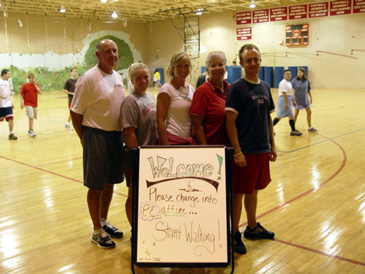
By the way, the teachers are not standing behind the assignment
when the students walk in. They posed for the picture knowing
that Harry would show this picture all over the world when he
lectures. They wanted to show how well they can
think and implement.
If you want to see how another high school physical education
teacher implements this technique, please go to November 2001,
“The
Effective Teacher Thinks.”
Like Stacey, we do not believe in giving teachers pat answers
on what to do. We would prefer to share what other teachers
have done successfully in their own classrooms, regardless of
grade level and subject matter, and allow each teacher to generate
his or her own classroom management plan.
This is the approach we take in our eLearning course on Classroom
Management. We present how over 30 teachers manage their
classrooms, ranging across the spectrum of teachers. Over
half of the examples are high school teachers.
In fact, in the opening graphic two of the three teachers are
high school teachers.

Our assignment to the person taking the eLearning course is to
reflect on what these teachers are doing and create a binder with
their own classroom management plan.
When Susan Riedel of Galveston, Texas, finished the online course,
she said:
“I have come away with a great binder that will
help me
organize my classroom. This was truly an exciting course.”
See www.ClassroomManagement.com
for more information.
Procedures, Procedures, Procedures,
Effective teachers have procedures and these procedures are part
of a classroom management plan. Procedures transcend all
grade levels and all academic subjects. Classroom
management applies to ALL teachers.
What we share is not just for elementary teachers. It is
not just for secondary teachers. It is for all teachers.
In fact we received a letter recently from a college instructor,
Susan Monfet, of Montclair State University and Bloomfield College
in New Jersey. She says, “I teach Classroom Management.
In searching for information for teaching the course, I came across
your book and the online program. I have since adopted your
book as a text for the class. The information was not only
useful for my students for the management of their own classrooms,
I also found the information useful for me as a college
instructor in managing my college classes.”
Regardless of the grade level or subject area taught, all well
managed classrooms have similar procedures, such as:
Bell work assignment
Opening morning procedures
Students entering procedures
Students leaving procedures
Walking in the hall procedures
Procedure if student finishes early
Getting the class’s attention
Quieting the class procedure
Listening to/responding to questions
Getting the teacher’s attention
Roll taking procedure
Collecting papers
Distributing papers
Disaster drill procedures
End of class/day dismissal procedures
And more…
Investing in Student Success
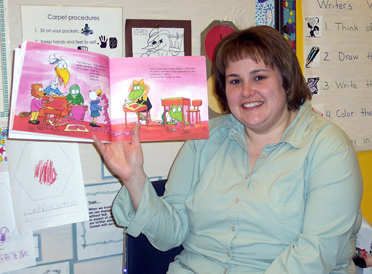
Sue Moore teaches kindergarten in Hobart, Indiana.
She was present at one of Stacey Allred’s classes and was
introduced to The First Days of School and
saw the video series, How to Be an Effective Teacher.
She said she had an immediate Aha, because she recognized the
positive impact that specific procedures and routines could have
in her kindergarten classroom.
She reflected on areas in her classroom that needed consistent
procedures the most. She thought. She implemented.
She began by writing and implementing carpet time, center time,
and table procedures. Later, she added restroom and coatroom
procedures.
These procedures were so successful that she incorporated procedures
into her Writer’s Workshop curriculum.
Then she had a magnificent Aha. She made visual
charts to remind her students of all the procedures.
These were created because she wanted all of the procedures to
be seen and understood by all of her students: non-readers,
as well as students with special needs.
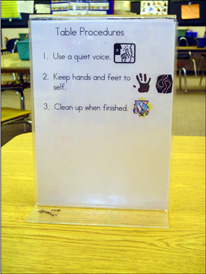
She searched for clip-art to illustrate each procedural step
and then hung the charts at the appropriate locations within the
classroom. Additionally for the table procedures, she placed
them in stands so everyone at the tables could see them.
It worked great!
Click here
to see more of her classroom procedures.
She taught the procedures using the three-step method explained
on page 177 of The First Days of School.
She happily remarked that the procedures became automatic routines
in several weeks.
Sue said that the time invested in practicing and rehearsing
the procedures was well worth it! For instance, when one
of her students ran from the classroom to the coatroom, another
student corrected him by pointing to our coatroom procedure sign
and reminding him that our first procedural step is to “Walk.”
She says, “My young students have become much more independent
and are very clear of my expectations. Consequently, I have
more opportunity during the school day for individualized instruction.
“My kindergarten classroom is on the road to becoming a
well-oiled learning machine!”
She Stole a High School Technique
Before going further, please review last month’s article,
“Students
Want a Sense of Direction.”
We featured three teachers; two of them were Diana Greenhouse
and Karen Rogers. Diana used a technique called “Inner-Outer
Discussions." This is how she got or “stole”
the technique. She has a daughter in tenth grade and this
technique was used by her high school English teacher.
Diana took this high school technique and modified it
for her fifth grade class.
Procedures Are a Work in Progress
Karen Rogers is a high school teacher in Kansas.
Last month she shared her scoring guide or rubrics in "Student
Wants a Sense of Direction."

This month we are excited to share her first day of school script
or classroom management plan.
Click here
to see a Power Point presentation of her classroom procedures.
Here are some of Karen's comments about her presentation.
1. As a master record of classroom procedures
It is a great feeling to have all my classroom procedures written
down in one location. On Power Point, my list is easily
accessible and can be modified as needed.
2. At the beginning of the school year
I think it is very important to explain, rehearse, and reinforce
procedures at the very beginning of the school year and throughout
the year as well. I spend about 20 minutes explaining
procedures with the Power Point. Sometimes I give students
points for writing down the most important procedures, such
as entering class, quieting the class, and dismissing class.
3. As a reminder, or reinforcer
I print, post, or refer to certain slides on the Power Point
to reinforce a procedure. For example, if students start
lingering at the door or talk as they enter the classroom instead
of getting seated and getting to work, I remind them of the
proper procedure to enter the classroom. Sometimes I will
hold up a printed copy of the slide. Then I check on them
the next day. I either thank them for doing it properly,
or I remind them of the procedure again and have them practice
the proper procedure for entering the classroom.
4. Something to share with others
The key to good classroom management is having procedures and
routines in place. I am happy to share with other teachers
who can use my Power Point presentation to customize and create
their own master list of procedures.
5. Work in progress
I review and revise my classroom procedures every August before
school starts. It helps me reset myself so I am prepared
for students. Procedures and routines improve
the classroom climate and maximize the learning time for students.
Karen says, “Procedures are such an important part
of classroom management. They work at all levels.
In my high school classroom, if I don't reinforce a procedure
throughout the year (for example, being seated for dismissal)
it becomes a management problem later in the school year when
I spend time at the end of the hour repeatedly saying, "Be
seated."
“With procedures, I take time to remind students about
the dismissal procedure, I practice it that day, and I thank students
for doing it right. Students get used to it and they expect
it.
“I simply and strongly believe in the power of
procedures. I used to lack confidence thinking
teaching procedures seemed like I was talking down to high school
students. However, if I didn't rehearse and reinforce, I
regretted it later.
"Now I embrace the fact that I teach procedures in the classroom
and I make a big deal about procedures. It gives me student
engagement.
My high school classroom flows much more smoothly with
procedures than without!
Observe, Reinvent, and Implement
What works in a kindergarten class works in any other
classroom.
What works in a high school classroom also works in any
other classroom.
All you have to do is observe what successful teachers do, regardless
of what or where they teach. Then you prepare yourself to
have an Aha moment and modify the technique for your classroom.
It’s then all yours to use with success.
And don’t forget to share your success with others.
Allow others to observe what you do in the classroom, share a
list with a colleague, demonstrate a technique at a workshop so
that others can steal from you and modify your work for their
classrooms.
Become a catalyst of success for teachers—no
matter what
grade or subject matter they teach!
 For a printable version of this article click
here.
For a printable version of this article click
here.
Harry & Rosemary Wong products: http://www.harrywong.com/product/
Email Harry Wong: harrywong@teachers.net
Gazette Articles by Harry & Rosemary Wong:
If you spot a link that appears to be out-of-date, please alert us at webmaster@teachers.net!
- A Grateful Goodbye After 15 Years (Jun 2015)
- Love, Marriage, and Babies, Oh My! (May 2015)
- Retention Rate Is 100 Percent (Apr 2015)
- Teacher Effectiveness and Human Capital (Mar 2015)
- Training Teachers to Be Effective (Feb 2015)
- Making Deals Is Ineffective (Dec 2014 / Jan 2015)
- Retrieving and Carrying Electronic Devices (Nov 2014)
- Sharing to Succeed (Oct 2014)
- How a University Prepares Its Students (Sep 2014)
- Effective Teaching (Aug 2014)
- Your Future Is in Your Hands (June/July 2014)
- The Classroom Management Book (May 2014)
- When Students Succeed; Teachers Succeed (April 2014)
- Teaching New Teachers How to Succeed (March 2014)
- Execute and Praise (February 2014)
- Shaping a Solid Foundation (Dec 2013 / Jan 2014)
- The Most Misunderstood Word (November 2013)
- How to Start Class Every Day (October 2013)
- Prevention: The Key to Solving Discipline Problems (September 2013)
- Planning, Planning, Planning (August 2013)
- Are You THE One? (June / July 2013)
- Practical Examples That Work (May 2013)
- A Disability Is Not a Handicap (Apr 2013)
- Totally Inexcusable (Mar 2013)
- Be Proud of Public Education (Feb 2013)
- Structure Will Motivate Students (Dec 2012 / Jan2013)
- Orchestrating the Classroom (Nov 2012)
- The Lasting Impact of Instructional Coaching (Oct 2012)
- Learning, Laughing, and Leaving a Legacy (Sep 2012)
- Twenty-two, First Year, and Legit (Aug 2012)
- A Master Teacher of Teachers (June/July 2012)
- Where Going to School Means Success (May 2012)
- A Nationally Celebrated High School (Apr 2012)
- The Highest Rated School in New York City, Part 2 (Mar 2012)
- The Highest Rated School in New York City, Part 1 (Feb 2012)
- The Importance of Culture (Dec 2011 / Jan 2012)
- You Can Teach Classroom Management (Nov 2011)
- Seamless, Transparent, and Consistent (Oct 2011)
- Coaching Teachers to Be Effective Instructors (Sep 2011)
- How a Principal Creates a Culture of Consistency (Aug 2011)
- Graduation Begins in Your Classroom (June/July 2011)
- The Inspiration of a Mother (May 2011)
- How to Be an Effective Leader (Apr 2011)
- Learning Objectives: The Heart of Every Lesson (Mar 2011)
- Even Shakespeare Had Structure (Feb 2011)
- Effectiveness Defined: It's Not a Mystery (Dec 2010 / Jan 2011)
- Surviving Without a Principal (Nov 2010)
- Achieving Greatness: Locke Elementary School, Part 2 (Oct 2010)
- Teaching Greatness: Locke Elementary School, Part 1 (Sep 2010)
- Effective from the Start (Aug 2010)
- Ten Year Summary of Articles, 2000 to 2010 (June/July 2010)
- The Success of a Culture of Consistency (May 2010)
- Training Teachers to Be Effective (Apr 2010)
- Learning to Teach, Teaching to Learn (Mar 2010)
- Turning Teaching Dreams into Reality (Feb 2010)
- Dreams and Wishes Can Come True (Dec 2009 / Jan 2010)
- Success in a State Controlled School (Nov 2009)
- Inner City Is Not An Excuse (Oct 2009)
- Exceeding All Expectations (Sep 2009)
- Teachers Are the Difference (Aug 2009)
- Nine Year Summary of Articles, 2000 to 2009 (Jun/Jul 2009)
- Teachers Are the Greatest Assets (May 2009)
- The Tools for Success (Apr 2009)
- Assessing for Student Learning (Mar 2009)
- To Be an Effective Teacher Simply Copy and Paste (Feb 2009)
- The Sounds of Students Learning and Performing (Dec 2008)
- A School That Achieves Greatness (Nov 2008)
- Boaz City Schools: Professional Learning Teams (Oct 2008)
- It Was Something Close to a Miracle (Sep 2008)
- A Computer Teacher Shows the Way (Aug 2008)
- Eight Year Summary of Articles, 2000 to 2008 (Jun/Jul 2008)
- An Amazing Kindergarten Teacher (May 2008)
- Schools That Beat the Academic Odds (Apr 2008)
- Academic Coaching Produces More Effective Teachers (Mar 2008)
- Coaches Are More Effective than Mentors (Feb 2008)
- Wrapping the Year with Rap! (Dec 2007/Jan 2008)
- The Floating Teacher (Nov 2007)
- Taking the Bite Out of Assessment—Using Scoring Guides (Oct 2007)
- Ten Timely Tools for Success on the First Days of School (Sep 2007)
- First Day of School Script - in Spanish, Too! (Aug 2007)
- Seven Year Summary of Articles, 2000 to 2007 (Jun 2007)
- Effective Teachers End the Year Successfully (May 2007)
- Training Gen Y Teachers for Maximum Effectiveness (Apr 2007)
- Classroom Management Applies to All Teachers (Mar 2007)
- Students Want a Sense of Direction (Feb 2007)
- Rubrics in Two College Classes (Dec 2006/Jan 2007)
- How to Write a Rubric (Nov 2006)
- Assessing Student Progress with a Rubric (Oct 2006)
- A 92 Percent Homework Turn-in Rate (Sep 2006)
- Effective Teachers Are Proactive (Aug 2006)
- Five Year Summary of Articles (Jun 2006)
- Hitting the Bulls Eye as a Beginning Teacher (May 2006)
- They're Eager to Do the Assignments (Apr 2006)
- The Success of Special Ed Teachers (Mar 2006)
- What Teachers Have Accomplished (Feb 2006)
- Fifty Years Ago, The Legacy (Dec 2005/Jan 2006)
- The Emergency Teacher (Nov 2005)
- Classroom Management Is Not Discipline (Oct 2005)
- A Successful First Day Is No Secret (Sep 2005)
- The Most Important Factor (Aug 2005)
- Four Year Summary of Articles (Jul 2005)
- Improving Student Achievement Is Very Simple (Part 2) (Jun 2005)
- Improving Student Achievement Is Very Simple (Part 1) (May 2005)
- Never Cease to Learn (Apr 2005)
- His Classroom Is a Real Life Office (Mar 2005)
- The Power of Procedures (Feb 2005)
- The First Ten Days of School (Jan 2005)
- PowerPoint Procedures (Nov/Dec 2004)
- The Saints of Education (Oct 2004)
- How Procedures Saved a Teacher's Life (Sep 2004)
- How to Help Students with Their Assignments (Aug 2004)
- Three Year Summary of Articles (Jun/Jul 2004)
- His Students are All Certified (May 2004)
- What to Do When They Complain (Apr 2004)
- A Well-Oiled Learning Machine (Mar 2004)
- The Effective Teacher Adapts (Feb 2004)
- How to Start a Lesson Plan (Aug 2003)
- Applying for a Teaching Job in a Tight Market - Part 2 (Jun/Jul 2003)
- Applying for a Teaching Job in a Tight Market (May 2003)
- The Effective Substitute Teacher (Apr 2003)
- A First Day of School Script (Mar 2003)
- How to Retain New Teachers (Feb 2003)
- No Problem With Hurricane Lili (Dec 2002)
- A Class Size of 500 (Nov 2002)
- Effective Practices Apply to All Teachers (Oct 2002)
- Dispensing Materials in Fifteen Seconds (Sept 2002)
- How To Start School Successfully (Aug 2002)
- Teaching Procedures Is Teaching Expectations (June - July 2002)
- $50,000 to Replace Each Teacher (May 2002)
- Even Superintendents Do It (Apr 2002)
- Impossible, No Job Openings? (Mar 2002)
- A Stress Free Teacher (Feb 2002)
- A Most Effective School (Jan 2002)
- Van Gogh in Nine Hours (Dec 2001)
- The Effective Teacher Thinks (Nov 2001)
- How a Good University Can Help You (Sep 2001)
- How to Motivate Your Students (May 2001)
- How to Recognize Where You Want to Be (Apr 2001)
- What Successful New Teachers Are Taught (Mar 2001)
- A Journey of the Heart (Feb 2001)
- The Miracle of Teachers (Jan 2001)
- It's Not the Students. It's the Teacher. (Dec 2000)
- The First Five Minutes Are Critical (Nov 2000)
- How to Start a Class Effectively (Oct 2000)
- The Problem Is Not Discipline (Sep 2000)
- There Is Only One First Day of School (Aug 2000)
- Applying for Your First Job (Jul 2000)
- Your First Day (Jun 2000)
Browse through the latest posts from the Classroom Management
Chatboard...
- introduce myself!, 2/05/26, by Innerpeaceful One | Study Timers & Sleep Music.
- intorduce myself, 2/05/26, by Innerpeaceful One | Study Timers & Sleep Music.
- classroom management resources, 2/05/26, by Innerpeaceful One | Study Timers & Sleep Music.
- Re: Learning by doing, 4/22/22, by WendyF.
- Re: Learning by doing, 4/22/22, by WendyF.
- Re: Learning by doing, 4/22/22, by WendyF.
- Re: Learning by doing, 4/22/22, by WendyF.
- Re: Learning by doing, 4/22/22, by WendyF.
- Re: Learning by doing, 4/22/22, by WendyF.
- Classroom Management and SRL, 2/08/21, by monh.
- Class Updates Application, 2/02/18, by edtechguru.
- Re: how do you manage the different learning styles?, 1/16/18, by Steven G.
- Re: Respectful and Responsible , 1/09/18, by Linda.
- Re: how do you manage the different learning styles?, 1/03/18, by Linda.
- how do you manage the different learning styles?, 12/28/17, by smgalbr810.
- Re: Why I'll Never Say "Don't Smile Until Christmas", 10/02/17, by CrystalB.
- Re: Positive Reinforcement, 10/02/17, by CrystalB.
- Re: Learning by doing, 10/01/17, by CrystalB.
- Re: Intrinsic Motivation - making sure we stay on task, 10/01/17, by CrystalB.
- Re: Intrinsic Motivation - making sure we stay on task, 10/01/17, by Heather S..
- Re: Is Positive Reinforcement Enough?, 10/01/17, by mollyh.
- Re: Is Positive Reinforcement Enough?, 10/01/17, by Heather S..
- Re: Is Positive Reinforcement Enough?, 9/30/17, by CrystalB.
- Re: Intrinsic Motivation - making sure we stay on task, 9/30/17, by CrystalB.
- Intrinsic Motivation - making sure we stay on task, 9/30/17, by CrystalB.
- Re: Respectful and Responsible , 9/30/17, by Alexandra Sletten.
- Re: Respectful and Responsible , 9/30/17, by Ines K.
- Is Positive Reinforcement Enough?, 9/30/17, by Heather S..
- Re: Respectful and Responsible , 9/29/17, by Anne R.
- Re: Respectful and Responsible , 9/28/17, by Samantha M.
- Re: Rewards, 9/28/17, by Samantha M.
- Re: Rewards, 9/28/17, by Kaylee H.
- Re: Respectful and Responsible , 9/28/17, by mollyh.
- Re: Rewards, 9/28/17, by mollyh.
- Re: Learning by doing, 9/28/17, by Heather S..
- Why I'll Never Say "Don't Smile Until Christmas", 9/27/17, by Bob R/CA.
|


 Chatboards
 Mailrings
 Classifieds
 Lessons
 Jobs
Jobs
 Projects