
 Teacher Feature...
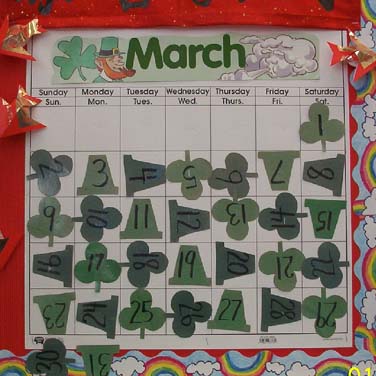
Calendar and Computations by Michael Moore Primary teachers are always looking for ways to spice up calendar time and to integrate as much curriculum as possible into those few daily moments. Here's a way I've integrated math concepts and skills into calendar time that has been extremely effective in providing a daily review of math facts and such concepts and skills as patterning, geometric transformations (flips, slides and turns), integers, decimals, order of operations and the use of brackets. For the past few months the patterns on our calendars have involved repeated shapes and geometric transformations. In March the pattern consisted of light green shamrocks and dark green hats. Both shapes and colours remained constant, but the hats and shamrocks made quarter turns clockwise.
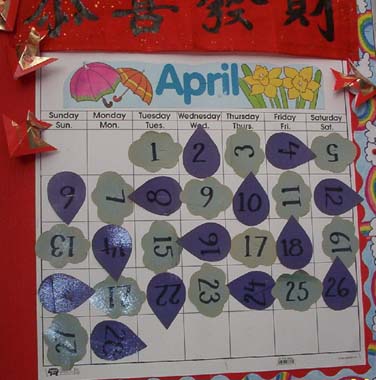
Most recently in April, the pattern consisted of clouds and raindrops. The shapes and colours remained constant but the clouds turned one quarter turns counterclockwise and the raindrops turned one quarter turns clockwise.
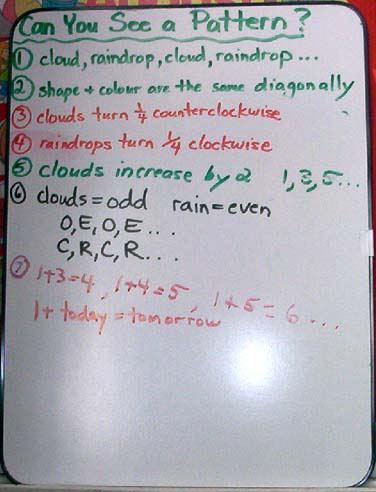
Each day the student who volunteered to do calendar had to demonstrate how to make the pattern by performing the transformations and describing them aloud as they did them (e.g "Slide one box down and then slide five boxes left and make a one quarter turn clockwise."). Often , I would ask if there was another way (fewer or more moves required) to make the tranformation. We also kept a written list on a small whiteboard of all of the patterns students could see on the calendar grid, with an emphasis on using correct terms and vocabulary to describe the patterns (e.g. ABAB, increasing pattern, decreasing pattern, constant, odd, even, horizontal, vertical, diagonal).
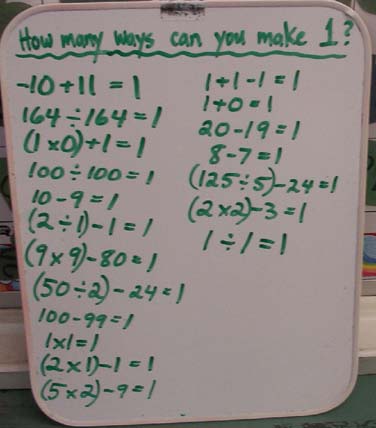
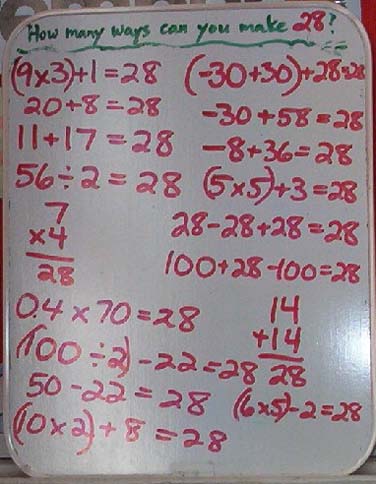
Finally at the end of every calendar session, we did How Many Ways Can You Make...? as a way of reviewing computations. The volunteer began by listing three different equations to make the day's number which I wrote on a small whiteboard. The rest of the class then could brainstorm equations often including multiple operations, brackets, integers and decimals. Some days, as a test, we skipped the class brainstorming and students individually wrote their own lists of equations.
I have always been one for integration, but even I am amazed at how effective this integrated calendar math is, especially for students who struggle the most. Integration, it's a good thing!
Michael Moore Browse the latest posts on the Chatboard:
|



 New Jobs on Teachers.Net