|

 Chatboards
 Mailrings
 Classifieds
 Lessons
 Jobs
Jobs
 Projects
|
  |

|



 Schools That Beat the Academic Odds | |||||||||||||||
| by Harry & Rosemary Wong Special to the Gazette April 1, 2008 |
|||||||||||||||
|
|||||||||||||||
|
New teacher attrition would disappear and student achievement would sky rocket! In Arizona, where 25 percent of the population is Latino, many schools have low achievement and low graduation rates; yet there are schools performing well enough to beat the national test-score odds. The Center for the Future of Arizona published a study, Beat the Odds: Why Some Schools with Latino Children Beat the Odds . . . and Others Don’t. The report can be read at www.arizonafuture.org. The paper cited several schools, including some along the Arizona–Mexico border, that were doing quite well. The continued success of schools that were considered high-achieving and the newfound success of schools that were once labeled underperforming had little to do with funding, class size, reading programs, parent involvement, or tutoring. In fact, those attributes were found in high- and under-achieving schools. The schools that beat the odds had these characteristics:
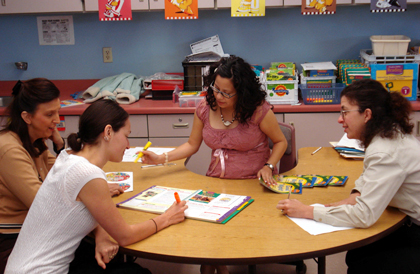
L. C. Kennedy School in the Creighton School District in Phoenix, Arizona, was recognized as one of the schools that beat the odds. You can understand why when you look and listen to the first grade team. They are (left to right) Patricia Hicks (team leader), Karen Schnee, Julie Kunitada, and Jenny Lopez.
When asked how they were able to break the odds and have their students do so well, they said, “We are ‘experts in the trenches.’” No whining. No complaining about the students dealt to them. Rather, their professional attitude reflects their dogged determination not to let anything stand in the way of their students’ success. This team teaches English language learners and reports that their success “comes from evaluating test scores regularly, The emphasis at Kennedy school is on the use of Professional Learning Communities (PLC). They say, “By meeting weekly, we have created a learning community of teachers that tackle problems and issues. Our team is flexible and pliable, stubborn and persistent. We accept ownership of the children and believe that all children can learn.
“Most importantly, we never give up.” Seamless New Teacher Transition When she was a new teacher, Julie Kunitada joined the L. C. Kennedy staff, and the other members of the team brought her up to speed quickly by reviewing yearly objectives and discussing how to reach goals. The school did not assign her a mentor. Everyone in the team, available at all times, was more than her mentor. They were her teammates. Julie Kunitada says, “I was not thrown in, but lovingly accepted into the family.”
Everyone operates in isolation. The money spent on mentoring annually has never shown results in sustained, improved student learning.
The National Commission on Teaching and America’s Future says in its publication, Induction into Learning Communities,
The Key Word Is WE This past year team leader Patricia Hicks became a literacy coach. Click here to see the responsibilities of a literacy coach. Patricia says that she has gone to several conferences and enjoys a learning curve that moves exponentially in leaps and bounds!! The school districts pays for and invests in the development of its coaches. Her responsibility is to go into teachers’ classrooms and informally observe their teaching and meet with them later to discuss any problems or successes they have. Patricia says, “I love my new job and think that I am making a difference with kids.” Today the best districts coach, not mentor, their new teachers and place them in learning teams to develop their teachers to state-specified proficiencies. Click here to see how this was explained in our February column, “Coaches Are More Effective than Mentors.”
Patricia continues, “I enjoy working with new teachers. Adrien Zabriskie replaced me on the grade level team. She is a first year teacher and soaks up everything I give her. When I suggested doing a model lesson in her room, she asked if she could tape it and look at it later. The next day, I heard her use some of the same phrases that I used in the lesson. What a joy to work with someone like that!”
The members of the first grade team this year are (left to right) Julie Kunitada, Adrien Zabriskie, Jenny Lopez (team leader), and Karen Schnee. In many schools in similar communities where the students come from high poverty families with a high minority enrollment, there is a churn of teachers and administrators every year and no capacity or culture is created. Yet, the staff at L. C. Kennedy staff is relatively stable. Why? Read what Adrien Zabriskie has to say about when she joined the staff. Then, read Jenny Lopez’s description of her experience when she became the new team leader. Starting with Adrien Zabriskie, she comments on her first year as a teacher, “The team members I work most closely with hold the profession of teaching and student learning to very high standards. Student success is at the forefront of every meeting or conversation we have, and it is always a collaborative effort to come up with ways in which we can ensure our students will succeed.”
“The key word is WE. I have never once felt like I was going at this alone. As team members we share ideas, they model many lessons for me, and I learn something valuable every time. “I lucked out because the people I work with have great personalities and I feel comfortable asking them for help. They would do well in any position because they are hard workers and are always willing to share ideas or advice. I really have some great models and some large shoes to fill.” So, here is a happy and successful brand new teacher. Why? Teachers are more effective and they find the
work more satisfying New teachers want to be accepted, to be part of a team, to contribute to the good of the students. It was easy for Julie and Adrien and any other future new teacher to slide seamlessly into an existing team that had goals and a vision of student learning. The reason the teams are so successful is because they have concrete assessment tools to work with, instead of fuzzy “reflective conversations.” During the PLC time the teams look at Dynamic Indicators of Basic Early Literacy Skills (DIBELS) data. These are a set of standardized, individually administered measures of early literacy development and are used to regularly monitor the development of pre-reading and early reading skills. The teams, with the help of the literacy coaches, look at the DIBELS test scores and monitor progress to improve instruction. Seamless Leadership Transition Jenny Lopez assumed leadership of the first grade team from Patricia Hicks. Here are Jenny’s observations:
It’s the team approach to learning that helps them beat the odds. This is as opposed to new teachers who teach in isolation and may have an assigned mentor who comes by once a week to ask, “How can I help you?” The beginning teacher then returns to the classroom to teach in isolation. Worse, there is no administrative monitoring of this vague mentoring process. Is it any wonder why half of the new teachers leave the profession after only a few years? In addition, do we see why student learning never improves? The students and the teachers who fail The grade-level teams at L. C. Kennedy do not function in isolation. They communicate with the teams at other grade levels. There is horizontal and vertical articulation. The Sixth Grade Team
Meet the members of the sixth grade team at L. C. Kennedy. They are (left to right) Lisa Jakubisin (team leader), Becky Gustafson, and new teacher, Jason Bourne. They are departmentalized and teach math, science, and language arts respectively to all sixth graders. They share, “While we have a team leader out of the necessity of needing a point of contact, our team is founded on mutual respect and sharing all responsibilities. We have developed a unified bond that is based on a foundation of respect we feel towards each other as professionals.” They have developed a common goal. This is how they describe their team: “We share a philosophical approach to the monumental task at hand. “Our task is to cultivate students rich in character and academic skills. “To achieve our goal of reaching all students, we have developed a unified procedural approach to the school day. “For example, the beginning of each school day starts with all students lining up, not into individual classes but as a unified grade. “With each teacher visible, we say the pledge and observe a moment of silence. This sends a clear message to the students that each child is our responsibility and we, as their teachers, are unified in every aspect of their educational process. “From that point, our students report to their home base for brief administrative purposes. After this five-minute process, students begin their rotation through our classes. “We have, from the first day of school, established procedures and high academic and social expectations that are consistent in each classroom. This consistency has created a strong sense of student accountability. As we have progressed throughout the year we have sensed the students are following our model of caring, fairness, responsibility, and citizenship.” Why the Sixth GradeTeam Succeeds Good teams—well formed and well led—achieve more than any individual can. Good teams are able to make optimal decisions when stressful situations occur. Team members can support and reinforce one another to do what they could never do on their own. Teamwork is less stressful. The sixth grade team shares, “Our team is in constant communication with each other. This may be a brief student update before class transition, a working lunch when ideas are discussed, or an after school formal meeting to review the data of each student. “Although formally we meet once a week, our team makes it a priority to informally talk before school and after the students leave to put into place interventions. This effort has resulted in minimal referrals, suspensions, and classroom behavioral issues. In addition, our open lines of communication have resulted in increasing test scores and positive classroom experiences. “Part of the positive classroom experiences have resulted from a unified teaching approach. While teaching strategies are shared and presented in a consistent manner, the teachers’ individual personality help keep these strategies fresh. This too, reflects a philosophy we share. We believe in team but respect the individuality of each other and our students.” A new teacher, Jason Bourne, joined the team this year. His acculturation was seamless and he was immediately productive because a team culture existed! They even said, “We had to stop and think. Although this is Jason’s first official year of teaching, he does not seem to be a new team member. “Jason demonstrates a passion for teaching students and reaching them as well. His passion is evident in his knowledge, dreams, and ideas. Jason not only shares with us, but takes our experience, knowledge, dreams, and ideas and incorporates these into his daily interactions with the students.” If every new teacher had this feeling because
of team support, A Team with a Collective Dream The sixth grade team continues, “Our success as a team is also attributed to this idea: we each have gifts we bring to the table. In recognizing the individual strengths and respecting our differences we collectively share a dream. This dream is how we create a functional family that can effectively face the daily challenges of education. Our family members are students, parents, peers, and administration. “Part of our responsibility to the school staff is open communication. It is important for us to cultivate conversations with the other teams at the school—vertically and horizontally. “These conversations are to prepare the students transitioning to our class as well as from our class. We share what has been effective for us as a team and listen to ideas of what is working with the groups being promoted to our care next year.
“As with every successful group, it is not just our team. Part of our strength lies in the support we receive from each member of the faculty, staff, and administration.”
Look at the great sport teams of today: the football Patriots and the basketball Pistons. There are no prima donnas, no malcontents. They win because they talk like a team, work like a team, and play like a team. It’s so obvious why they win. It Is So Obvious How to Have Successful Students and Teachers Decades of research has confirmed what L. C. Kennedy does to foster student learning.
If all of this is known and even common sense, then what’s the problem? Sabrina Laine, director of the National Comprehensive Center for Teacher Quality (NCCTQ) says, “There seems to be a chronic inability or unwillingness for the education system to embrace new ideas, which is a tragic mismanagement of human capital. Programming new teachers to a broken and outdated system rather than harnessing their boundless potential will set education back another decade. Whether or not educational leaders nurture or negate the ideas of Gen Y teachers will be a litmus test for their ability to lead to a knowledge-driven economy.” One of the outdated ideas Sabrina Laine refers to can best be summarized by Kathleen Fulton and her colleagues at the National Commission on Teaching and America’s Future, who say, “Unless we move beyond the traditional one-to-one mentoring model, we will continue to reinforce the Industrial-era practice of stand-alone teaching in isolated classrooms.” Very simply, we have a new GenerationY group of teachers. Today’s new teachers have grown up connected to their peers in unprecedented ways. They are accustomed to working, learning and playing in teams. Their lives are built around social networking. They thrive in environments filled with collegial learning. New teachers want to observe others, to be observed by others, and to be part of networks of professional learning communities where all teachers share together, grow together, learn to respect each other's work, and collaboratively become leaders together. One-on-one mentoring, done sporadically and resulting in the new teacher teaching in isolation, does not work. An induction program enables new teachers to begin teaching on day one with the knowledge that they are an integral part of their school. And it enables them to continue through their tenure contributing to the knowledge base of both teachers and students.
Schools Exist to Help Students Learn Please review the past two columns. Click here to read the February column and here to read the March column. With this column, these three columns were written for the major reason schools exist —to help students learn. For students to learn, hundreds of research studies have shown that the major factor in student learning is an effective teacher. You do not produce effective teachers by buying programs, making changes in the school structure, promoting an ideology, or providing a mentor with no purposeful academic goals. You produce effective teachers by training them,
continuously, The more effective the teacher, the more the students will learn. Sports teams and companies—even non-profits—know this. A new player is signed. The player joins a TEAM. The team is initially divided into squads of players who play a specific position. These squads are given coaches —yes, often more than one—who have a responsibility, to coach the players to their maximum playing potential. The players are not given mentors to go and “reflect.” The coaches meet often with the manager as the players become united into a functioning team with one purpose—to win games. Companies do the same. New employees are ushered into a TEAM. These employees undergo training from the day they are hired to the day they leave—all for the purpose of developing better and better employees. The better the employees, the better the company’s productivity. The more effective schools and school districts have long since discovered this practice. New teachers are hired and immediately and seamlessly acculturated into an existing TEAM that has goals, practices, and procedures in place. Then every member of the team serves as support to the new teacher with everyone sharing information to enhance the productivity of the team. In turn, the school has coaches and these coaches have well defined responsibilities to help teachers, and the teams produce more effective student learning. The coaches meet regularly with the administrators,
teachers, and If you already have a variation of such a plan in place, please share it with us. Let us hear from you at HWong@harrywong.com. Creating a collaborative culture is the single
most important factor Be a Team We not only want your students to achieve and learn, we want YOU to succeed. The more support systems there are in place for you, the chances are you won’t become one of those statistics leaving the profession before you even begin to realize your potential. The secret to your survival is not to isolate yourself. Induction programs bring teachers together. Team centered learning brings teachers together. If these structures aren’t in place at your school, then be proactive about it. The Internet is the gateway for collaboration and learning with teachers far and near. Teachers.net is a great launching pad for you to begin your journey. Team up with other educators who are like you, who want to connect and learn from each other, to help children reach their potential. There are no excuses for you not to succeed, only opportunities waiting for you to retrieve. Have you Googled today? Don’t know where to start? Try “collaboration” and discover “The Power of We!”
 For
a printable version of this article click
here. For
a printable version of this article click
here.

 »
More
Gazette articles... »
More
Gazette articles... |
|||||||||||||||
| |||||||||||||||