|

 Chatboards
 Mailrings
 Classifieds
 Lessons
 Jobs
Jobs
 Projects
|
  |

Effective Teaching... by Harry and Rosemary Wong
To print: Select File and then Print from your browser's menu
------------------------------------------------------------------
This article was printed from Teachers.Net Gazette,
located at https://teachers.net.
------------------------------------------------------------------
September 2007
Ten Timely Tools for Success on the First Days of School
We teach you to plan so you can plan to teach.
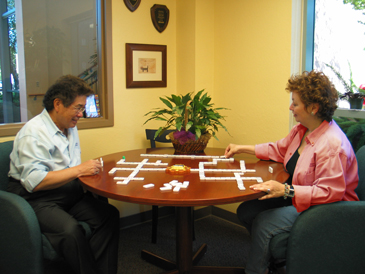
We love to play Mexican Train®. For those who are not familiar with this game, it’s a dominos type game where there are three or more games going on simultaneously—at the same time! There’s your game, your opponents’ games, and a side game called the Mexican Train.
The game requires strategy, intelligence, and skill. It can get intense, but when it’s over there is usually a smile and the winner can even say, “That was fun.” Fun is the result of a well-played game.
Ask anyone who has done a report or paper. The process requires diligence, hard work, and perseverance. But if the result is a good grade or commendation, then the writer can sit back and smile at the accomplishment and then correctly say, “That was fun.” But it was no fun doing the process. It was hard work.
It is so common for new teachers to come into the profession with the mantra of “school should be fun.” Where they acquire this buzz is unknown as the schools of education surely don’t teach that. They teach classroom management, instructional delivery, assessment for learning, student engagement, parental relationships, educational psychology, differentiated instruction, problem solving, positive expectations, inclusive classrooms, and a host of other skills that are required of an effective teacher.
Schools are institutions of instruction and learning. The purpose of school is for students to acquire knowledge, learn skills, and develop habits and principles that will make them productive citizens and help them grow to their fullest potential as human beings. (The First Days of School, page 5.)
We love fun, but fun is not the purpose of a lesson. Fun is the satisfaction that results when a lesson is completed with accomplishment and achievement. So, when we play Mexican Train, we play to win. Fun comes over our faces after accomplishing a well-played game.
Students can achieve this same kind of satisfaction with their lessons. When you design a lesson for student learning, you design it backwards. Backward design contends that instead of planning a lesson around a fun or bunch of favorite activities, a more effective lesson should start with the end results you want to achieve. Then, plan backwards to what you can do to bring student accomplishment of that goal. Accomplishment of the goal will bring joy to the students and will make them eager to want to achieve more.
Effective Classrooms Are Consistent
For a student to demonstrate accomplishment and achievement in school, there must be a plan that organizes the classroom for student learning and success.
The most important factor to establish the first week of school is consistency. A consistent classroom has no surprises. Everyone knows how the classroom is organized and structured for learning. Effective teachers have a classroom that is structured, organized, and CONSISTENT in how the classroom is run.
As with any game, the more you play it, the better you become familiar with the rules and strategies that operate that game. There is consistency to the rules, you know what happens. Even when you land on “Go to Jail,” you sigh and move your marker there—without begging for second chances or blaming it on someone else. You accept the structure of the game and know it’s there to ensure that you have a great time while you’re playing.
Here are some of the items you’ll want to make sure you use consistently in your classroom to better the chances of your students winning each and every day.
- BEGINNING NEEDS OF STUDENTS. Students want to know seven things on the first day of school: 1) Am I in the right room? 2) Where am I supposed to sit? 3) What are the rules in this classroom? 4) What will we be doing this year? 5) How will I be graded? 6) Who are you as a person? 7) Will I be treated as a human being? Have answers to these questions ready and use them as part of your welcome to the students on the first day of school. Help can be found in our August 2000 column, “There Is Only One First Day of School,” and in The First Days of School, page 105.
- CLASSROOM MANAGEMENT PLAN. Sarah Jondahl began as a first-year teacher six years ago, with a binder complete with a classroom management plan. She had a plan for how she wanted to operate her classroom. She knew the procedures she wanted her students to follow. With procedures in place, she says, “The educational experience in my classroom is extremely effective.” Use Sarah’s plan to help you plan for your student’s success. The plan can be seen in our September 2005 column, “A Successful First Day Is No Secret,” and at www.ClassroomManagement.com.
- SCRIPT. Diana Greenhouse, third-grade teacher near Fort Worth, Texas, starts her school year with a PowerPoint script of her classroom management plan. It’s ready to show to students who miss the opening of school and is a terrific Show and Tell for Back to School night. Diana says, “When I look back at all I’ve accomplished in one school year, it takes my breath away. My students learned. I loved every minute of teaching, and it all started with that very first minute of the first day of school.” Her PowerPoint can be seen in our October 2005 column, “Classroom Management Is Not Discipline,” and for more information read The First Days of School, page 95.
- BELLWORK. Chelonnda Seroyer, English teacher in Alabama, says that she spent two months preparing for one day, the first day of school. On her first day as a first-year teacher, her students entered her classroom and began to work immediately, and every day thereafter. She has an assignment posted and it is posted in the same location every day. There is a consistent procedure in her classroom and the students know that when the bell rings, they are to get to work immediately. Chelonnda’s plan can be seen in our February 2005 column, “The Power of Procedures,” and for more information read The First Days of School, page 124.
- ATTENTION PROCEDURE. Barbara DeSantis can bring her class to attention in five seconds by calmly saying, “Give me five, please.” This is because she knows the steps to teach a procedure, which are 1) Clearly state and demonstrate a procedure; 2) Rehearse the procedure; and 3) Assess the rehearsal and reinforce the procedure. All procedures must be rehearsed, until the procedure becomes a routine. Her plan can be seen in our August 2006 column, “Effective Teachers are Proactive,” and for more information read The First Days of School, page 184.
- HAND SIGNALS. While students are working, you can reduce the noise level in the classroom by using a set of hand signals. For instance, one finger could indicate a desire to speak, two fingers a desire to leave the seat, and three fingers to request help from the teacher. You respond by shaking your head or waving a hand that responds, “Yes,” “No,” or “Wait.” This technique can be seen in The First Days of School, page 187.
- DISTRIBUTION OF MATERIALS. We know that students learn best with hands-on activities. Do not place materials on a central table and have continuous student movement in the classroom. Rather, place all materials needed for the activity in a container and post an inventory of the contents of the container in the classroom. Assign a student to carry the container to the group for the activity and return it after checking the inventory list that is posted. This technique can be seen in our September 2002 column, “Dispensing Materials in Five Seconds.”
- SCHOOL-WIDE PROCEDURES. The most effective schools have procedures that are used consistently by all teachers. These are ready and posted on the first day of school. Students can move from teacher to teacher knowing what to do. For instance, they know that all classrooms have an assignment, so they enter all classrooms knowing what to do and start their assignment. Work with your colleagues to get some general procedures established at your grade level teaching team or your school. A school with such a plan can be seen in our January 2002 column, “A Most Effective School.”
- TEACH TO AN OBJECTIVE. The effective teacher tells the class the objective of the lesson. You determine what you want your students to learn, perhaps based on state or district standards, and then you backward design a lesson to begin with an objective or objectives. Objectives are student learning targets. When the students know what they are aiming for, they know what they are responsible for learning.
Julie Johnson of Minnesota structures her lessons as follows: 1) She determines what she wants her students to learn; 2) She shows them what they are to learn; 3) They practice what they are to learn; and 4) They are tested on what they are to learn. She says, “There is no secret as to what is expected of them. When I do this they all succeed.” If students know what they are to learn, you greatly increase the chances that the students will learn. Julie’s technique can be seen in our April 2006 column, “They’re Eager to Do the Assignment” and in The First Days of School, page 241.
- ASSESS FOR LEARNING. The purpose of a test is not to grade the student. The results of a test are to be used to assess for learning. When a doctor gives a patient a test, such as a blood test, the results are not used to grade the patient. The results are used by the doctor to assess the patient’s health and to determine if any medication or treatment is needed to improve the patient’s health. Likewise, an effective teacher uses the results of a test to determine what instruction is needed to improve the learning of a student. Several columns were written in 2006 and 2007 on this subject. One is October 2006, “Assessing Student Progress with a Rubric.”
How well you begin school with an organized, consistent, and well managed classroom will determine your success and your students’ success for the rest of the school year.
With procedures firmly in place, you will have time
to devote yourself to the art and craft of teaching and
become the effective teacher your students need and deserve.Success Begins with You
You are the determiner of success in your classroom. Not only by what you do, as in the “Ten Timely Tools,” but more importantly in your attitude and belief in children and your ability to make a difference in their lives.
- Believe that every child who enters your classroom this year wants to grow and learn and be successful and has the capacity to do so.
- Believe in yourself that you have the skills needed to reach children and move them to new heights.
- Believe that every day is a new day with the opportunity to start anew.
- Believe that you are part of a greater community of educators who are proud of their profession and dedicated to their calling.
- Believe that the smile of welcome you radiate to your students everyday will warm the hearts of more bodies that you will ever imagine.
- Believe in partnerships with colleagues, administrators, and parents that will nurture children.
- Believe that you are both a teacher and a learner and grow yourself professionally each year.
- Believe that hard work is required of success.
- Believe that education is the bedrock for humanity.
- Believe that we are here to help you and your students achieve success.
The result of writing this month’s column has been a fun experience for us. It has required us to think back to our classrooms and recall what was helpful at the start of school. It has required us to review past teachers.net articles and share with you some outstanding colleagues. It has required us to think about our perception of education and what it means to us. The pleasure and enjoyment of this process is what has created the smiles, the chuckles, and the energy to keep writing and sharing.
Make your school year one of pleasure and enjoyment packed with learning for you and your students.
Harry & Rosemary Wong products: http://EffectiveTeaching.com
This printable version is provided for the convenience of individuals.