About Ginny Hoover...
Recently, Teacher TimeSavers has published a variety teaching units and tutoring hookups that Ginny wrote and designed. These include a literary unit for Taming the Star Runner, Hookups for Language Arts, Transcripts of Trials for Goldilocks, The Wolf, and Mr. Dad, and Tactile/Kinesthetic Activity Patterns.
The Gifts of Children by Hoover and Carroll Killingsworth, a book about recognizing, acknowledging, and refining the gifts of children, is scheduled to be published some time this year. Visit Teachers Helping Children--The Gifts Project for additional information.
Ginny's Eclectic Middle School pages
Ginny Hoover took an early retirement after 31 years of teaching in Kansas public schools. Her experience spans the 5th through 8th grades. During the last ten years she has functioned as a trainer of teachers in a variety of areas in her district, surrounding districts, professional organizations, and teacher service centers. At the state level Ginny is a state trainer and a writing assessment grader for the KS State Writing Assessment (based on the Six Traits Writing Model), a member of the Kansas Social Studies Committee for writing the social studies standards, benchmarks, and indicators, and the lead trainer for the state in government and civics.
 The Gifts of All Children
$16.50
More information
 The Eclectic Teacher
by Ginny Hoover Talking about the Six Traits and Quality Writing The one thing I could do for my students that would really change the quality of their writing was helping them to select their topics wisely. Two factors are very important:
If you are scoring a paper to learn about the skills of the writer, then the prompt needs to be general enough that the writer really has many choices. If you are scoring a paper to combine knowledge obtained and writing skills, expect a lower quality of writing. Why? The student no longer has a wide range of choices and depth of knowledge becomes a factor. How and when do we teach Ideas and Content? I think it needs to be taught within the writing process---brainstorming. It is here, before the pencil hits the paper for the rough draft that students need to consider their choices wisely. To consider the quality of an essay topic after the essay is written is a bit late. If the topic didn't work, think of all of the wasted time. No, the time to consider the wise choice of topics is at the beginning. . .during brainstorming, when starting over again it if the topic wasn't working would mean very little time lost. Mind mapping for brainstorming--here's a plan that might help--toss out, modify, or start over to fit your teaching style---whatever. I posted this information on the Six Traits board, but it will soon scroll off, so I'm including it now. May I say also that some people would rather brainstorm in a list format? I see nothing wrong with that, and the only disadvantage is the mind-mapping format provides a loose organization that listing does not provide. Begin by having students get out paper & pencil. Teacher uses transparency.
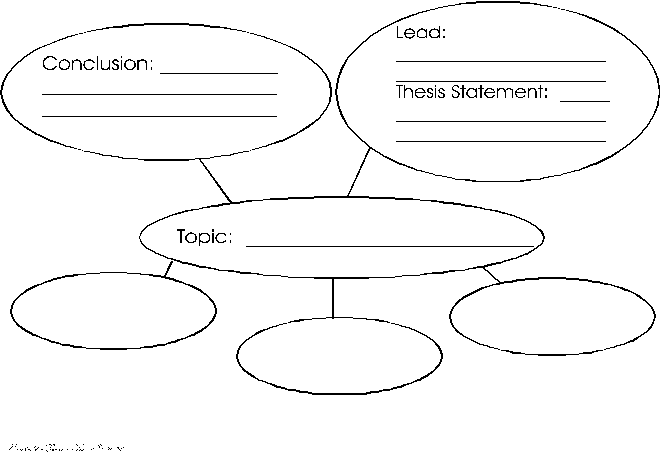
Quality brainstorming will lead to better essays. It gives the student a method of exploring their level of understanding. If they start brainstorming and can't think of anything, it is a good indicator that the topic is not acceptable for their writing piece. I have handouts that I give students with a graphic for each type of writing. When we study compare/contrast for example I have students use mind mapping but instead of drawing circles from the center, I have student draw an extension in a Venn diagram. There is a graphic for cause/effect I use--when students see they have a cause/effect situation, they use that graphic extended from the center circle. The following is an organized mind mapping for an essay that I hand my students to use as a guide for their rough drafts. You'll notice they must write a lead, thesis statement, and a concluding statement BEFORE they start their rough drafts. (How can you get from point A to Point B if you don't know where they are? It's the same in writing---the beginning and end!) I have students use their brainstorming mind mapping and to look for clusters of good ideas. Next, I have them find the ones that seem to naturally fit together. Those are the ideas that will be included on the organized mind mapping. I provide 3 circles below for supporting paragraphs. One of the first things I explain is that they can mark out one if they don't need it or they can add others. Each of these circles becomes paragraphs, so my students rarely have trouble paragraphing.
I model, model, model for them. I use partnerships for support. They also get lengthy lessons in how to write leads, thesis statements, and concluding statements. There is quite a bit of information on my site on the modes and how to develop paragraphs. At http://www.geocities.com/ginnyks Once the organized mind mapping is complete, students write a rough draft, key it into the computer using MLA format, use spell check and thesaurus, edit & revise, and publish. I take students through the these steps the first time we do them. It allows students to learn the writing process. I have them follow this process all year and they must hand in proof of each step on every essay we complete. (I allow them to personalize these steps once they understand the writing process.) Every once in awhile--like when we start a new mode of writing, we will mind map a few days to have ideas to put into the file and to give the student choices. Visit Ginny's Educational WebPages!
Gazette Articles by Ginny Hoover:
Browse the latest 25 posts from the 6 Traits Chatboard:
|