

Density of a Material
- Science
- Senior
- Activity Time
- Materials
- Concepts / Topics
Purposes
- To determine the density of a material you create.
- To observe physical and chemical changes.
- To observe chemical properties.
- To observe physical properties.
- To apply the method of weighing by difference.
Equipment and Materials
- Graduated cylinders (10 mL and 50 mL)
- Balance (triple beam)
- Stirring rod
- Weighing paper
- Teaspoon (plastic)
- Large plastic cup
- Small plastic cup
- Sodium borate solution (4%)
- Guar gum powder
- Food coloring (optional)
Procedure
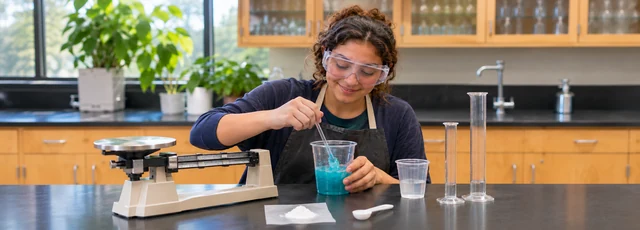
- After taking safety precautions (goggles and apron; gloves optional), determine the mass of the large plastic cup. Record the mass. Add up to five drops of food coloring: use the same color, different colors, or none, but no more than five drops total. Determine and record the mass of the cup plus food coloring. Add water to the third ring of the large plastic cup, using your graduated cylinder. Read the cylinder carefully and record the volume. Determine the mass of the water, cup, and optional food coloring. Determine and record the mass of the guar gum powder given to you.
- Determine the mass of the small plastic cup. Fill this cup half full with sodium borate solution, using your graduated cylinder to determine the volume. Determine and record the mass of the cup plus the sodium borate solution.
- Slowly dissolve the guar gum powder into the water/food coloring solution. Stir at all times. Add the powder slowly, breaking up any chunks before adding it to the water solution. This solution should become more viscous but still be quite fluid.
- When all of the guar gum has dissolved, add the sodium borate solution all at once. Immediately stir. Continue stirring, observing any changes that may occur. Stir for approximately 3 minutes.
- Scrape as much material as possible off the stirring rod and back into the cup. Determine and record the mass of the large cup plus the material.
Data Tables
Before Mixing the Water/Food Coloring Solution with the Sodium Borate Solution
Record the following measurements and calculations.
| Item | Measurement or calculation | Value |
|---|---|---|
| 1 | Mass of large plastic cup, water, and food coloring | ________________ |
| 2 | Mass of large plastic cup plus food coloring | ________________ |
| 3 | Mass of large plastic cup | ________________ |
| 4 | Mass of weighing paper + guar gum | ________________ |
| 5 | Mass of weighing paper | ________________ |
| 6 | Mass of guar gum | ________________ |
| 7 | Mass of sodium borate solution + cup | ________________ |
| 8 | Mass of small plastic cup | ________________ |
| 9 | Mass of sodium borate solution | ________________ |
| 10 | Volume of water | ________________ |
| 11 | Volume of sodium borate solution | ________________ |
| 12 | Volume of water/food coloring + sodium borate (add items 10 and 11) | ________________ |
| 13 | Mass of water + guar gum + food coloring (if used) + sodium borate solution | ________________ |
After Mixing the Water/Food Coloring Solution with the Sodium Borate Solution
Divide the mass of the mixture (line 13) by the volume of the mixture (line 14) to determine the density of the material. Show your work here.
The density of my material is: _______________________________
Questions
- Discuss the changes that occurred as you stirred the guar gum into the water.
- Discuss the changes that occurred after the sodium borate was added to the water/guar mixture.
- What is density?
- What chemical changes did you see occur?
- Was there a chemical change involving the food coloring? Did the solution remain the same color?
- What is a mixture?
- Is the product a mixture? Why or why not?
- Explain the process of weighing by difference.
- What physical properties seem to have changed, if any?
- What is guar gum normally used for?
Teachers.Net · https://teachers.net/lessons/109.html