Find Lessons
What's All This Money madness?
Count and compare a collection of pennies, dimes, and quarters whose total value is $2.00 or less.
MathematicsElementary (K–5)Animal Coverings MIni Lesson
Students will read Animal Coverings and create an interactive writing piece that demonstrates their knowledge of the reading material.
ScienceElementary (K–5)Sight Word Journal Writing
Students will be able to recall sight words when they see them in text.
LiteratureElementary (K–5)Analogies, Synonyms, Antonyms, Stories and Writing!
Students will understand the difference between synonyms and antonyms using analogies.
Reading/WritingMiddle School (6–8)Columbus Journals
Use information from prior lessons and incorporate information into writing.
Reading/WritingElementary (K–5)Dinosaur/Writing Mini Lesson
Create a meaningful opportunity for children to sound out dinosaur names after drawing their favorite dinosaur on a prepared journal sheet, with a drawing box at the top and lined space for words at the bottom.
Reading/WritingElementary (K–5)Determining the Identity of Unknows by Using Solubility Rule
Solubility rules, identifying unknowns, and double replacement/precipitation reactions
ScienceHigh School (9–12)Interative History Notebook Mini-lesson
The interactive notebook is a place for students to review and connect with content vocabulary and events. It gives students the freedom to draw pictures, write a poem, draw a comic, write a response or story, or use a visual such as a graphic organizer to…
Social StudiesHigh School (9–12)Tessellations
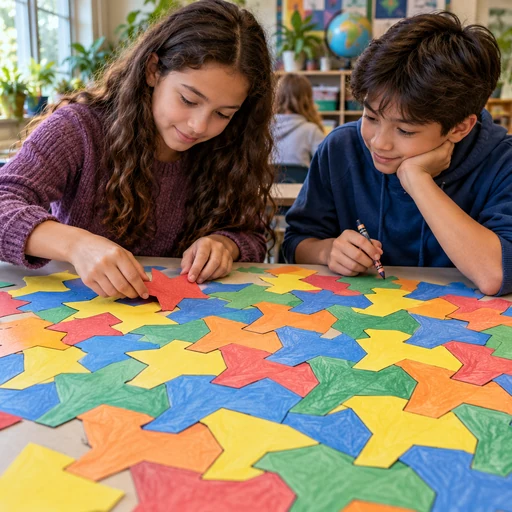
Students will be able to imitate the work of M.C. Escher by creating tessellations using the three basic attributes of tessellations and one of three types, then identify tessellations and their types on a worksheet.
MathematicsMiddle School (6–8)