About Marvin Marshall...
Marvin Marshall is a professional speaker and seminar leader who presents his program, "Discipline without Stress, Punishments, or Rewards - Raise Responsibility and Promote Learning," to schools across the world.
His program was developed upon his returning to full-time teaching after 24 years of counseling, supervision, and administration. He has taught primary and upper elementary grades and has been an elementary school principal. He has taught all middle grades and has been a middle school counselor and assistant principal. He has taught all high school grades and has been a high school counselor, assistant principal of supervision and control, assistant principal of curriculum and instruction, and high school principal. He has also served as a district director of education.
Dr. Marshall, who is certified by the William Glasser Institute, presents for Phi Delta Kappa International, for several leading seminar companies, and for schools and school districts. His presentation schedule is on the calendar of his website.
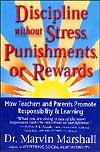
In his book Discipline without Stress, Punishments, or Rewards - How Teachers and Parents Promote Responsibility & Learning, he clearly and concisely demonstrates how the external approaches of relying on rules, imposing consequences, rewarding students for appropriate behavior, and punishing students to make them obey are all counterproductive.
The book can be purchased from the National Association of Elementary School Principals, the National Association of Secondary School Principals, the National School Boards Association, Phi Delta Kappa, at local bookstores, or from his website www.MarvinMarshall.com.
Visit Marvin Marshall's Homepage to read more.
To read about the failings of punishments and rewards, go to
www.AboutDiscipline.com
 Promoting Learning...
by Dr. Marvin Marshall
Approaches of Outstanding Teachers
Reflection and Approaches
of outstanding teachers
Reflection has a number of attributes. At the top of the list is that reflection prompts gratitude--which is the key to both happiness and goodness.
In learning, reflection reinforces what we want to remember. This is the reason that I encourage teachers to use some strategy such as "Think, Pair, Share" at the conclusion of every lesson. To use "brain terminology," reflection makes temporary memory more permanent by strengthening neural connections.
Kerry--a teacher in British Columbia who explores the use of internal approaches to inspire students to learn--reflected on the teachers who had taught her over the course of her own schooling.
She shared with me some attributes of her own outstanding teachers--those who clearly stood out in her memory as effective and inspiring.
What characteristics did these educators share?
They had cultivated personal bonds with students by:
- Treating them with respect and kindness
- Using an honest, direct teaching approach
- Showing interest in them as individuals
- Sharing stories of their own lives
- Maintaining an approachable manner so they felt safe
- Displaying a willingness to give extra help and encouragement
They had held high expectations for students by:
- Requiring them to work hard
- Insisting that they try
- Challenging them to think
- Expecting them to behave appropriately
They had employed best teaching practices:
- Capturing interest through an engaging classroom environment
- Providing a reason to want to step into the classroom
- Making learning fun
- Utilizing a variety of carefully planned teaching strategies
- Giving varied and meaningful assignments
Use a little reflection now. Ask yourself the following question:
"If you were a student, would you want yourself as a teacher?"
If you hesitate in your answer, reflect on Kerry's list. For your own benefit, you may discover an area you may wish to improve--aside from the benefits your students will receive.
Ideas for implementing the discipline system that promotes both responsibility and learning using concepts of Stephen Covey (proaction), William Glasser (noncoercion), W. Edwards Deming (collaboration and empowerment) and Abraham Maslow (hierarchy and autonomy) is described at http://www.MarvinMarshall.com
Subscribe to the free monthly newsletter, PROMOTING RESPONSIBILITY, at http://www.DisciplineWithoutStress.com.
Enter e-mail address and click on "Subscribe."
 For a printable version of this article click here.
Dr. Marshall's website: http://www.MarvinMarshall.com
Email Dr. Marshall: marvmarshall@teachers.net
© Dr. Marvin Marshall, 2003.
Questions submitted to Kathleen Carpenter at kathleen@teachers.net will be considered by Marv Marshall for responses in future monthly columns in the Teachers.Net Gazette.
Gazette Articles by Dr. Marshall:
- Ronald Reagan and the Art of Influence (June 2009)
- Discipline Is a Liberating Word (May 2009)
- Eliciting vs. Punishments (Apr. 2009)
- Habit vs. Awareness for the 3 Practices and for the Hierarchy of Social Development (Mar. 2009)
- How to Be Consistent (Feb. 2009)
- Teaching is an Art, Not a Science (Jan. 2009)
- Tapping Into Internal Motivation (Dec. 2008)
- People Do Better When They Feel Good (Nov. 2008)
- The Brain and Sleep (Oct. 2008)
- Using a Butterfly Analogy to Explain the Hierarchy of Social Development (Sept. 2008)
- 5 Classroom Tips (Aug. 2008)
- Discipline Without Stress, Inc. (July 2008)
- Visualization (June 2008)
- Promoting Responsibility - Or How Not To (May 2008)
- Immaculate Perception (April 2008)
- A System Is Superior To Talent (Mar. 2008)
- To promote responsibility, Elicit Rather Than Impose (Feb. 2008)
- Understanding Boys (Jan. 2008)
- Descartes' Error: I think; therefore, I am (July 2003)
- Metacognition -- Thinking about Thinking Is Essential for Learning (June 2003)
- Listening Lessons -- How to Help Kids Learn and Comprehend (May 2003)
- Approaches of Outstanding Teachers (Apr 2003)
- Using a Discipline Approach to Promote Learning (Mar 2003)
- Curriculum, Instruction, Classroom Management, and Discipline (Feb 2003)
- Learning and Relationships, The two are inseparable (Jan 2003)
- Accountability in Schools (Dec 2002)
- Suggestions For Motivation (Nov 2002)
- Given Names - When NOT to Use Them and when TO Use Them (Oct 2002)
- The Power Of Hierarchies (Sept 2002)
- Use the Language You Want Learned (Aug 2002)
- Observations From Last Year (July 2002)
- How The Horse Whisperer Trains a Wild Mustang in 30 Minutes (June 2002)
- Using Breath Management for Better Listening and Voice Preservation (May 2002)
- Reducing Stress By Promoting Responsibility--Rather than by Attempting to Manipulate Behavior (Apr 2002)
- Rules Vs. Expectations (Mar 2002)
- How to Achieve 100 Per Cent Student Participation (Feb 2002)
- Positivity, Choice, and Reflection Exercise for Students (Jan 2002)
- Learning Climate (Dec 2001)
- Reflection and Self-Evaluation (pt 3) (Nov 2001)
- Reflection and Self-Evaluation (pt 2) (Sep 2001)
- Reflection and Self-Evaluation (pt 1) (May 2001)
- The Empowerment Of Choice (pt 2) (Apr 2001)
- The Empowerment Of Choice (pt 1) (Mar 2001)
- Power Of Positivity (pt 2) (Feb 2001)
- Power Of Positivity (Jan 2001)
- Home Assignments (Dec 2000)
- Collaboration is the Key (Nov 2000)
- Classroom Meetings (Aug 2000)
Browse through the latest posts from the Classroom Discipline Chatboard...
- Paddling students over 18, 5/31/18, by Renee Parker .
- Choir Discipline, 11/14/17, by Nancy.
- Discipline Issue -- Choir, 11/14/17, by Nancy.
- Re: This is for PBIS Tier II coaches, 10/01/17, by Samantha M.
- Re: Parental follow-through with "discipline", 9/30/17, by Anne R.
- Re: A small change--a huge result, 9/30/17, by Alexandra Sletten.
- Re: A small change--a huge result, 9/30/17, by Alexandra Sletten.
- Re: PBIS , 9/30/17, by Alexandra Sletten.
- Re: Parental follow-through with "discipline", 9/30/17, by Alexandra Sletten.
- Re: Parental follow-through with "discipline", 9/30/17, by mollyh.
- Re: Parental follow-through with "discipline", 9/30/17, by mollyh.
- Re: Parental follow-through with "discipline", 9/30/17, by mollyh.
- Re: Parental follow-through with "discipline", 9/30/17, by mollyh.
- Re: Parental follow-through with "discipline", 9/30/17, by mollyh.
- Re: Parental follow-through with "discipline", 9/30/17, by mollyh.
- Re: Parental follow-through with "discipline", 9/30/17, by mollyh.
- Re: Parental follow-through with "discipline", 9/30/17, by mollyh.
- Re: Parental follow-through with "discipline", 9/30/17, by Heather S..
- Re: PBIS , 9/30/17, by Ines K.
- Re: PBIS , 9/30/17, by Ashley C.
- Re: Parental follow-through with "discipline", 9/30/17, by Ashley C.
- Re: Parental follow-through with "discipline", 9/29/17, by mollyh.
- Re: This is for PBIS Tier II coaches, 9/29/17, by Heather S..
- Re: PBIS Tier II , 9/29/17, by Samantha M.
- Re: Parental follow-through with "discipline", 9/29/17, by Samantha M.
- Re: Consistency with Discipline , 9/29/17, by Ines K.
- Parental follow-through with "discipline", 9/29/17, by mollyh.
- Re: Consistency with Discipline , 9/29/17, by KathleenO.
- Re: Consistency with Discipline , 9/28/17, by Anne R.
- Re: Consistency with Discipline , 9/28/17, by Anne R.
- Re: PBIS Tier II , 9/28/17, by Anne R.
- Re: Consistency with Discipline , 9/28/17, by Samantha M.
- Consistency with Discipline , 9/27/17, by Alexandra Sletten.
- Re: A small change--a huge result, 9/27/17, by Samantha M.
- Re: PBIS , 9/27/17, by Samantha M.
|
|
|
|
#





 New Jobs on Teachers.Net
