

Marvin Marshall

Promoting Discipline & Learning
Archive | Biography | Resources | Discussion

Ronald Reagan and the Art of Influence

How to influence and improve relationships
by Dr. Marvin Marshall
www.MarvinMarshall.com
Regular contributor to the Gazette
June 1, 2009

When you are about to engage in a disagreement, try the following:
Say, "I don't want to win; I just want to understand what you are saying. My objective is to clarify, not influence.

“You're saying that you believe A B and C. I believe A B and D. So don’t we really agree more than we differ?”

At the worst you have clarified. At the best you have minimized any disagreement.

In any event, it's good to know where you agree and where you differ.

The key is to state at the outset that your goal is not to win, but to clarify.

Clarity is not only more important than agreement, it often leads to influence itself.

Here is an example that changed a situation from "telling" and attempting to influence to asking a reflective question that—through clarification—influenced the world.

The events occurred on November 20, 1985 at Fleur d'Eau, Geneva, Switzerland, during the Geneva Summit meeting between the U.S. President, Ronald Reagan, and the USSR General Secretary, Mikhail Gorbachev. Gorbachev accused Reagan of lecturing him. Reagan responded that he (Reagan) had been misinterpreted.

Later that afternoon, Reagan asked Gorbachev (and just their interpreters) to go on a short walk to the cabin by the lake. During the conversation the president asked the following question to the general secretary, “If the United States were to be attacked by something from outer space, would the U.S.S.R. come to the rescue of the United States?”

Gorbachev responded, "Of course."

Reagan responded, "Me, too," meaning that it would be the same if the situation were to be reversed.

The question asked and the resulting responses immediately changed the relationship between the two world leaders and the beginning of the end to the "cold war."

To review, telling or lecturing (versus sharing) were reduced by asking a brilliant, reflective, and creative question. This led to clarification that influenced, improved relationships, and established a fresh mindset.

More on increasing effectiveness and improving relationships can be learned by subscribing to the free monthly newsletter, “Promoting Responsibility & Learning,” at www.MarvinMarshall.com.

Any school in the USA can receive free “Discipline Without Stress” books described at the above link by completing the application at DisciplineWithoutStress.org

Copyright © 2009 Marvin Marshall.


» More Gazette articles...


About Marvin Marshall...

His approach is the only system that is proactive, totally noncoercive, and does not use external manipulatives or threats. He INDUCES students to WANT to act responsibly and WANT to put forth effort to learn.
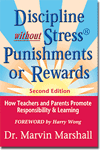
His book, "Discipline without Stress® Punishments or Rewards - How Teachers and Parents Promote Responsibility & Learning" is used in schools, universities, and homes around the world. The book clearly and concisely demonstrates how external approaches of relying on rules, imposing consequences, rewarding students for appropriate behavior, and punishing students to make them obey are all counterproductive. His approach reduces stress and is more effective than traditional approaches that focus on obedience because obedience does not create desire.

A prime reason that the approach is the fastest growing discipline and learning system in the country and is taught in so many universities is that it teaches students to understand differences between internal and external motivation. A second reason is that the focus is on promoting responsibility; obedience then follows as a natural by-product. A third reason is that the system separates the deed from the doer, the act from the actor, a good kid from irresponsible behavior, thereby eliminating the natural tendency for a student to self-defend.

Dr. Marshall gives permission to download and reproduce anything from his websites as long as www.MarvinMarshall.com is included. Visit his teaching model at //www.marvinmarshall.com/in-housedetails.html.

He offers the following resources to learn and support his approach:

//www.marvinmarshall.com This is the foundational site that links to the teaching model, shares how a school can conduct its own in-house staff development, and contains free information for implementation. For a quick understanding of his approach, link to "THE HIERARCHY" and "IMPULSE MANAGEMENT."

//www.disciplinewithoutstress.com This is the website for the best-selling book on discipline and learning. Three sections of the book are online: Classroom Meetings, Collaboration for Quality Learning, and Reducing Perfectionism.

//groups.yahoo.com/group/DisciplineWithoutStress.com is used to post questions, share ideas, and give assistance.

//www.DisciplineAnswers.com has a compilation of previously asked and posted answers categorized from the above Yahoo site.

//www.AboutDiscipline.com explains reasons that external approaches - such as rewarding appropriate behavior, telling students what to do, and punishing them if they don’t - are not used to promote responsible behavior.

//disciplineforsmartpeople.com This web log (blog) contains short posts to help implement the totally noncoercive - but not permissive - approach.

NEW! Discipline Without Stress, Inc.- a nonprofit public charitable devoted to teaching the Discipline Without Stress Teaching Model, now being offered to low economic schools in the U.S.A.

Free books at //www.disciplinewithoutstress.com, free In-House Staff Development at //www.marvinmarshall.com/In_House_Package.html and, depending upon location, free personal presentations by Marv Marshall. For more information: //www.marvinmarshall.com/in-housedetails.html

The requirements for application can be found at //www.DisciplineWithoutStress.org


Marvin Marshall Columns on Teachers.Net...
Related Resources & Discussions on Teachers.Net...
#