|


 Discipline Is a Liberating Word Discipline is not a dirty word. A happy life is a disciplined life. | |
| by Dr. Marvin Marshall www.MarvinMarshall.com Regular contributor to the Gazette May 1, 2009 |
|
|
|
|
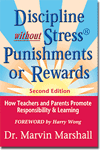
 Most people misunderstand the term “discipline.” A university professor once told me this term is so negative that he never uses it. Instead, he uses the phrase “classroom management.” As with so many educators, the professor mistakenly used these two terms as if they were synonymous. On the contrary, classroom management is about making instruction and learning efficient. This is the teacher’s responsibility. Discipline is about behavior and is the student’s responsibility. (More clarification between the two is available at www.marvinmarshall.com/classroom_management.html.) The ultimate goal of discipline is self-discipline—the kind of self-control that underlies voluntary compliance with expected standards. This is the discipline of mature character that a civilized society expects of its citizens. John Goodlad, one of my former professors, said that the first public purpose of schooling is to develop civility. This can only be achieved with self-discipline. In order for a society or classroom to be civil, discipline needs to be fostered. Yet, according to Richard E. Clark, Chair of the Division of Educational Psychology at the University of Southern California: Discipline is understood in a very limited way by most educators—“How do we get these children to behave?”—rather than, “How do we support the people in our charge as they learn to channel and direct their positive energy in ways that accomplish their goals and those of their community?” Although discipline is often referred to as punishment, this is only one of many interpretations of the word. In fact, Dr. Lee Salk, the author of eight books on family relationships and a former popular commentator on social change, domestic strife, and changing family patterns, stated in Familyhood: Nurturing the Values that Matter, on page 47: “What discipline is not is punishment.” He also stated, “Discipline isn’t a dirty word. Far from it! Discipline is the one thing that separates us from chaos and anarchy. Discipline implies timing. It’s the precursor to good behavior, and it never comes from bad behavior. People who associate discipline with punishment have a shortsighted view of discipline. With discipline, punishment is unnecessary.” The National Parent Teachers Association agrees. Their publication, “Discipline: A Parent's Guide,” states, "To many people, discipline means punishment. But, actually, to discipline means to teach. Rather than punishment, discipline should be a positive way of helping and guiding children to achieve self-control." “Discipline” is derived from the Latin word “disciplina,” which means instruction. The original meaning of the word connotes the self-discipline necessary to master a task. This is the self-discipline of the competitive athlete, of the professional musician, of the master craftsman, of the expert in any field. This type of discipline does not come from someone else telling a person what to do. Neither does this type of discipline come from receiving some external reward. External approaches to discipline such as telling, rewarding, threatening, and punishing are manipulative and rarely have long-lasting positive effects. In her book The Caring Teacher’s Guide to Discipline: Helping Young Students Learn Self-Control, Responsibility, and Respect, Marilyn Gootman writes that discipline is teaching self-control, not controlling or managing students. (p. 17) Julie Andrews believes that discipline is liberating. As she put it, “Some people regard discipline as a chore. For me, it is a kind of order that sets me free to fly.” A disciplined life leads to responsibility, increased effectiveness, and improved relationships. The book Discipline without Stress, Punishments, or Rewards teaches how to live a self-disciplined life, become more responsible, increase effectiveness, and improve relationships. And perhaps, just as important, it shares how to teach young people to WANT to be self-disciplined--both in behavior and in putting forth effort in their own learning. These are the topics covered each month in the electronic newsletter, "Promoting Responsibility and Learning" found at www.MarvinMarshall.com/newsletters. Copyright © 2009 Marvin Marshall. Any school in the USA can receive free “Discipline Without Stress” books described at the above link by completing the application at DisciplineWithoutStress.org 
  | |
|


 His approach is the only system that is proactive, totally noncoercive, and does not use external manipulatives or threats. He INDUCES students to WANT to act responsibly and WANT to put forth effort to learn.