


Marvin Marshall

Promoting Discipline & Learning
Archive | Biography | Resources | Discussion

Habit vs. Awareness for the 3 Practices and
for the Hierarchy of Social Development


Once something becomes a habit, awareness of it decreases.
by Dr. Marvin Marshall
www.MarvinMarshall.com
Continued from page 1
March 1, 2009

Since OBEDIENCE (LEVEL C) DOES NOT CREATE DESIRE, it is only motivation at Level D that brings the most personal satisfaction, as the following incident sent to me indicates.

Last night I purchased some items at the grocery store. When I took the bags out of my cart and prepared to leave the store for my car, I noticed I had a small key lime clutched in my hand that I had forgotten to put on the conveyor belt; so I hadn't paid for it. At ten for $1, it would have cost ten cents. My first thought was, I don't want to walk all the way back to a cashier for ten cents. The store won't miss that meager amount. Nevertheless, I pulled a dime from my wallet and walked back to the nearest cashier and handed it to her, explaining the reason. She replied by saying, “God bless you for your honesty.”

Well, I have to admit; I did feel better than I would have if I had simply walked to my car without paying the ten cents.

As we live, we experience various levels. If you have experienced great anger, chances are that you had little concern for the effect your behavior had on others (Level A). If you ever drove faster than the speed limit, you made your own rules of the road (Level B). If you were courteous and considerate of others, your motivation could have been to do what others were doing (Level C), or your motivation could have been to be courteous and considerate of others because that was the right thing to do (Level D).

NO ONE OPERATES ON LEVEL D ALL THE TIME. A major point about thinking about the hierarchy is to be continually aware of the level one chooses. It is like sitting up straight. You choose it, and then in a few minutes you realize that you are slouching again. Pull in your stomach for girth control (a conscious activity), and in a few minutes you realize that you are no longer "pulling it in." ONCE AN ACTIVITY BECOMES HABITUAL, YOU LOSE AWARENESS. Hence, although the idea sounds like a good one, a "Level E" would lose the significant step of ALWAYS BEING AWARE OF ONE'S CHOICES--a key to empowerment that so many young people need.

Great question! Thanks for asking.

By the way, the same "awareness" is necessary for the THREE PRACTICES: positivity, choice, and reflection. Are you aware when your self-talk and your communications to others are negative? Are you giving options to reduce coercion? Are you asking reflective questions such as, "What can I learn from this experience?"


» More Gazette articles...


About Marvin Marshall...

His approach is the only system that is proactive, totally noncoercive, and does not use external manipulatives or threats. He INDUCES students to WANT to act responsibly and WANT to put forth effort to learn.
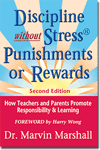
His book, "Discipline without Stress® Punishments or Rewards - How Teachers and Parents Promote Responsibility & Learning" is used in schools, universities, and homes around the world. The book clearly and concisely demonstrates how external approaches of relying on rules, imposing consequences, rewarding students for appropriate behavior, and punishing students to make them obey are all counterproductive. His approach reduces stress and is more effective than traditional approaches that focus on obedience because obedience does not create desire.

A prime reason that the approach is the fastest growing discipline and learning system in the country and is taught in so many universities is that it teaches students to understand differences between internal and external motivation. A second reason is that the focus is on promoting responsibility; obedience then follows as a natural by-product. A third reason is that the system separates the deed from the doer, the act from the actor, a good kid from irresponsible behavior, thereby eliminating the natural tendency for a student to self-defend.

Dr. Marshall gives permission to download and reproduce anything from his websites as long as www.MarvinMarshall.com is included. Visit his teaching model at //www.marvinmarshall.com/in-housedetails.html.

He offers the following resources to learn and support his approach:

//www.marvinmarshall.com This is the foundational site that links to the teaching model, shares how a school can conduct its own in-house staff development, and contains free information for implementation. For a quick understanding of his approach, link to "THE HIERARCHY" and "IMPULSE MANAGEMENT."

//www.disciplinewithoutstress.com This is the website for the best-selling book on discipline and learning. Three sections of the book are online: Classroom Meetings, Collaboration for Quality Learning, and Reducing Perfectionism.

//groups.yahoo.com/group/DisciplineWithoutStress.com is used to post questions, share ideas, and give assistance.

//www.DisciplineAnswers.com has a compilation of previously asked and posted answers categorized from the above Yahoo site.

//www.AboutDiscipline.com explains reasons that external approaches - such as rewarding appropriate behavior, telling students what to do, and punishing them if they don’t - are not used to promote responsible behavior.

//disciplineforsmartpeople.com This web log (blog) contains short posts to help implement the totally noncoercive - but not permissive - approach.

NEW! Discipline Without Stress, Inc.- a nonprofit public charitable devoted to teaching the Discipline Without Stress Teaching Model, now being offered to low economic schools in the U.S.A.

Free books at //www.disciplinewithoutstress.com, free In-House Staff Development at //www.marvinmarshall.com/In_House_Package.html and, depending upon location, free personal presentations by Marv Marshall. For more information: //www.marvinmarshall.com/in-housedetails.html

The requirements for application can be found at //www.DisciplineWithoutStress.org


Marvin Marshall Columns on Teachers.Net...
Related Resources & Discussions on Teachers.Net...
#