


Marvin Marshall

Promoting Discipline & Learning
Archive | Biography | Resources | Discussion

The Brain and Sleep

Our brains are busy while we sleep! Dr. Marshall discusses how the brain works during sleep, and how much sleep we REALLY need.
by Dr. Marvin Marshall
www.MarvinMarshall.com
Regular contributor to the Gazette
October 1, 2008

The brain evolved to use light and darkness wisely: acquire information by day; process it at night.

The effects of sleep on memory are impressive.

Recent discoveries show that sleep facilitates the active analysis of new memories, allowing the brain to solve problems and infer new information. The "sleeping brain" may also be selectively rehearsing the more difficult aspects of a newly learned task.

We may be able to get by on six hours sleep, but if we want to optimize learning and memory, closer to eight hours is better. Only with more than six hours of sleep does performance improve over the 24 hours following the learning session, according to the researchers, Robert Stickgold of Harvard University and Jeffrey Ellenbogen of Massachusetts General Hospital, who both study the interactions of sleep and cognition. (Scientific American MIND, August/September 2008, pp. 22 - 29)

The latest research suggests that while we are peacefully asleep, our brain is busily processing the day's information. While we sleep, the brain combs through recently formed memories, stabilizing, copying and filing them so that they will be more useful the next day. A night of sleep can make memories resistant to interference from other information and allow us to recall them for use more effectively the next morning.

Apparently, science is proving what I had intuitively known as a student. I would always study what I wanted to remember just before going to bed at night. Sleep, in all of its various phases, does something to improve memory that being awake does not do.

Sleep not only strengthens memories, it also lets the brain sift through newly formed memories. The process can also identify what is worth keeping and selectively maintaining and enhancing memory. The brain may have to shut off external inputs because unconscious cognition appears to use the same brain resources that are used for processing signals when we are awake.

When memory contains both emotional and unemotional elements, sleep can save the important emotional elements and let the less relevant background drift away. This processing plays a crucial role in the evolution of emotional memories.

Also, during sleep collections of memories are analyzed, and new relationships among inputs are made. Sometimes this processing helps find the meaning in what we have missed.

In a nutshell, the brain needs time after we learn to process the learning, and sleep provides the maximum benefit. Or to put it more simply, the brain learns while we sleep.

Points to Remember:

  1. While we sleep, our brain is processing information learned during the day.
  2. Sleep makes memory stronger and even appears to weed out irrelevant details and background information so that only the important pieces remain.
  3. Our brain works during slumber to find hidden relations among memories and to solve problems we are working on while awake.

Copyright © 2008 Marvin Marshall.

Additional information is available at www.MarvinMarshall.com


» More Gazette articles...


About Marvin Marshall...

His approach is the only system that is proactive, totally noncoercive, and does not use external manipulatives or threats. He INDUCES students to WANT to act responsibly and WANT to put forth effort to learn.
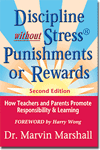
His book, "Discipline without Stress® Punishments or Rewards - How Teachers and Parents Promote Responsibility & Learning" is used in schools, universities, and homes around the world. The book clearly and concisely demonstrates how external approaches of relying on rules, imposing consequences, rewarding students for appropriate behavior, and punishing students to make them obey are all counterproductive. His approach reduces stress and is more effective than traditional approaches that focus on obedience because obedience does not create desire.

A prime reason that the approach is the fastest growing discipline and learning system in the country and is taught in so many universities is that it teaches students to understand differences between internal and external motivation. A second reason is that the focus is on promoting responsibility; obedience then follows as a natural by-product. A third reason is that the system separates the deed from the doer, the act from the actor, a good kid from irresponsible behavior, thereby eliminating the natural tendency for a student to self-defend.

Dr. Marshall gives permission to download and reproduce anything from his websites as long as www.MarvinMarshall.com is included. Visit his teaching model at //www.marvinmarshall.com/in-housedetails.html.

He offers the following resources to learn and support his approach:

//www.marvinmarshall.com This is the foundational site that links to the teaching model, shares how a school can conduct its own in-house staff development, and contains free information for implementation. For a quick understanding of his approach, link to "THE HIERARCHY" and "IMPULSE MANAGEMENT."

//www.disciplinewithoutstress.com This is the website for the best-selling book on discipline and learning. Three sections of the book are online: Classroom Meetings, Collaboration for Quality Learning, and Reducing Perfectionism.

//groups.yahoo.com/group/DisciplineWithoutStress.com is used to post questions, share ideas, and give assistance.

//www.DisciplineAnswers.com has a compilation of previously asked and posted answers categorized from the above Yahoo site.

//www.AboutDiscipline.com explains reasons that external approaches - such as rewarding appropriate behavior, telling students what to do, and punishing them if they don’t - are not used to promote responsible behavior.

//disciplineforsmartpeople.com This web log (blog) contains short posts to help implement the totally noncoercive - but not permissive - approach.

NEW! Discipline Without Stress, Inc.- a nonprofit public charitable devoted to teaching the Discipline Without Stress Teaching Model, now being offered to low economic schools in the U.S.A.

Free books at //www.disciplinewithoutstress.com, free In-House Staff Development at //www.marvinmarshall.com/In_House_Package.html and, depending upon location, free personal presentations by Marv Marshall. For more information: //www.marvinmarshall.com/in-housedetails.html

The requirements for application can be found at //www.DisciplineWithoutStress.org


Marvin Marshall Columns on Teachers.Net...
Related Resources & Discussions on Teachers.Net...
#